₹10 Lakh Lumpsum Investment: Calculate Potential Returns in 7 Years

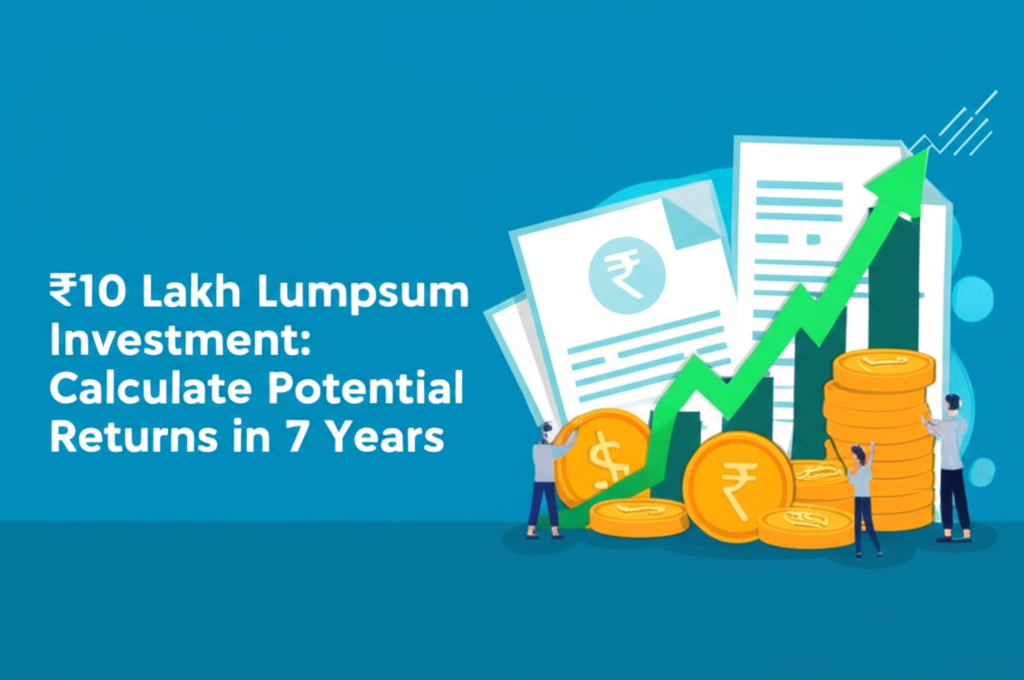
Imagine this: You’ve just received a fantastic bonus at work, or perhaps inherited a sum, or finally saved up a substantial amount like a cool ₹10 Lakh. It's sitting there in your savings account, earning a measly 3-4% interest, maybe even less after taxes. You’re happy, but also a little restless, aren't you? You know this money could do more, grow faster, and really work for you. That’s where the idea of a **₹10 Lakh lumpsum investment** comes in, especially if you’re looking at a decent time horizon, say, 7 years.
I’m Deepak, and over the last eight years, I’ve helped countless salaried professionals in India navigate the world of mutual funds. I’ve seen the excitement, the confusion, and ultimately, the satisfaction when their investments start to really pay off. Today, let’s talk about that ₹10 Lakh. How much could it realistically grow to in 7 years? And what’s the smartest way to make that happen?
₹10 Lakh Lumpsum: Navigating Lumpsum vs. SIP for a Healthy Start
When you have a significant amount like ₹10 Lakh sitting idle, the first question that pops up is often, "Should I put it all in at once, or spread it out?" This is the classic lumpsum vs. SIP debate. For a 7-year horizon, here’s my take.
If you're confident about the market's long-term trajectory and aren't afraid of short-term volatility, a lumpsum investment can be incredibly powerful. Why? Because it puts your entire capital to work from day one, maximising the power of compounding. Think of Rahul, a project manager in Pune, who got a ₹15 Lakh gratuity payment. He was initially hesitant to invest it all at once, fearing a market dip. But after discussing his 8-year goal of funding his daughter's education, we realised that time in the market beats timing the market, especially over such a period.
However, I also understand the apprehension. What if the market crashes right after you invest? That's a valid concern. Honestly, most advisors won't tell you this, but if market conditions are extremely volatile, or if you simply can't stomach the thought of an immediate dip, you could consider a hybrid approach. Invest, say, ₹3-4 Lakh as a lumpsum, and then set up a Systematic Transfer Plan (STP) for the remaining amount from a liquid or ultra-short-term fund into equity funds over the next 6-12 months. This allows you to gradually enter the market while keeping your money productive.
For a 7-year horizon, unless the market is at an all-time unsustainable peak (which is hard to predict anyway), a lumpsum tends to deliver better returns simply because of the longer compounding period. The key is to pick the right funds and stay invested.
Setting Realistic Expectations for Your ₹10 Lakh Investment Over 7 Years
Alright, let’s get to the numbers. Everyone wants to know the "potential returns." But here’s the thing: past returns are not guarantees. However, they do give us a good benchmark to set realistic expectations.
Over a 7-year period, equity mutual funds, particularly diversified ones, have historically delivered robust returns. The Nifty 50 and SENSEX, the bellwethers of the Indian stock market, have given average annual returns (CAGR) of around 12-15% over long periods (10+ years). For a 7-year horizon, I’d conservatively estimate anywhere from 10-14% CAGR for well-chosen equity funds. Why a range? Because market cycles happen, and nobody has a crystal ball.
Let's take a mid-point of 12% CAGR. If you invest ₹10,00,000 today and it grows at 12% per annum for 7 years, here’s how the calculation works:
- Year 1: ₹10,00,000 * (1 + 0.12) = ₹11,20,000
- Year 2: ₹11,20,000 * (1 + 0.12) = ₹12,54,400
- Year 3: ₹12,54,400 * (1 + 0.12) = ₹14,04,928
- Year 4: ₹14,04,928 * (1 + 0.12) = ₹15,73,519
- Year 5: ₹15,73,519 * (1 + 0.12) = ₹17,62,341
- Year 6: ₹17,62,341 * (1 + 0.12) = ₹19,73,822
- Year 7: ₹19,73,822 * (1 + 0.12) = ₹22,10,681
So, your ₹10 Lakh could potentially grow to over ₹22.1 Lakh in 7 years. That's more than double your initial investment! Imagine if it hit 14% CAGR, which isn't unheard of for good funds over this period. Your ₹10 Lakh would swell to over ₹25 Lakh!
This isn't magic; it's the power of compounding, working tirelessly in the background. Your money isn't just earning interest; your interest is earning interest. That's why a longer time horizon like 7 years is so crucial for equity investments.
Picking the Right Funds for Your Seven-Year ₹10 Lakh Investment Journey
Now, how do you achieve those kinds of returns? It starts with picking the right mutual funds. For a 7-year horizon, your risk appetite matters, but generally, you can lean towards equity-oriented funds. Here’s what I’ve seen work for busy professionals like you:
- Flexi-Cap Funds: These are my personal favourites for a diversified portfolio. Fund managers have the flexibility to invest across large-cap, mid-cap, and small-cap companies, adapting to market conditions. This agility can be a real advantage over a 7-year cycle. They’re great for growth without being overly aggressive.
- Large & Mid-Cap Funds: A good blend of stability from large-caps and growth potential from mid-caps. If you want a slightly more focused approach than a flexi-cap but still want decent diversification, these are solid.
- Balanced Advantage Funds (BAFs): If you’re a bit more conservative, or just want some inbuilt risk management, BAFs are fantastic. They dynamically manage their equity and debt allocation based on market valuations. When markets are high, they reduce equity exposure; when low, they increase it. This 'buy low, sell high' mechanism (automated by the fund manager) can smooth out returns over 7 years. They might offer slightly lower returns than pure equity but with significantly less volatility.
What about sectoral or thematic funds? While they can give phenomenal returns, they also come with higher risk. For a core ₹10 Lakh lumpsum investment, especially for goals like a house down payment or your child's education, I’d suggest sticking to diversified funds first. You can always add a smaller, satellite portion to a thematic fund if you have a very high-risk tolerance and specific conviction.
Always remember to check the fund's expense ratio, fund manager’s experience, and consistent performance (not just one stellar year). And yes, always invest through direct plans to save on commissions – AMFI's "Mutual Funds Sahi Hai" campaign has done a great job educating investors on this.
Common Mistakes People Make with Lumpsum Investments
Investing ₹10 Lakh is a big step, and it’s easy to stumble if you’re not careful. Here are some pitfalls I've seen people fall into:
- Holding Cash for Too Long: This is probably the biggest one. People wait for the "perfect" market entry point, which rarely comes. Every day your money sits in a savings account, it's losing purchasing power to inflation. Get in when you’re ready, and let time do its work.
- Chasing Past Returns: A fund that gave 30% last year might be a fluke, or it might be a sectoral fund that's already peaked. Don't invest purely based on eye-popping short-term returns. Look for consistency over 3, 5, and 7 years.
- Panicking During Market Corrections: Markets will fall. It's not a matter of if, but when. Your ₹10 Lakh might temporarily dip to ₹8.5 Lakh. This is where most people get scared and redeem their investments, locking in losses. This is the absolute worst thing you can do for a long-term investment. Ride it out. Market corrections are often opportunities for long-term investors.
- Not Reviewing Your Portfolio: While I advocate for a long-term view, it doesn't mean "invest and forget." Review your portfolio once a year. Is the fund still performing as expected? Has your financial goal or risk appetite changed? Are there better alternatives? Don't churn your portfolio frequently, but a periodic check-up is healthy.
- Ignoring Taxation: Long-term Capital Gains (LTCG) tax on equity mutual funds is 10% on gains exceeding ₹1 Lakh in a financial year. If you invest in an ELSS fund for tax saving under Section 80C, it comes with a 3-year lock-in. Be aware of these implications for your 7-year plan.
FAQs About Your ₹10 Lakh Lumpsum Investment
Q1: Is 7 years truly a "long-term" horizon for equity investments?
A: While 10+ years is often considered ideal, 7 years is certainly a good medium-to-long term horizon for equity mutual funds. It generally allows enough time to ride out market volatility and benefit from compounding, making it a reasonable period for significant wealth creation.
Q2: What if the market crashes after I invest my ₹10 Lakh? Should I panic?
A: Absolutely not! Market crashes are a normal part of the investment cycle. If you have a 7-year horizon, a crash early on might even be a blessing in disguise, allowing your investment to buy more units at lower prices. The key is to stay invested and not react emotionally.
Q3: Can I withdraw my money early if I need it before 7 years?
A: Yes, mutual funds (except ELSS funds with their 3-year lock-in) offer liquidity, meaning you can generally withdraw your money whenever you need to. However, exiting early from an equity fund, especially during a market downturn, could mean you haven't given your investment enough time to grow, potentially leading to lower returns or even losses.
Q4: Should I time the market when investing a lumpsum of ₹10 Lakh?
A: Market timing is incredibly difficult, even for seasoned professionals. Unless you have a very strong, well-researched view (and even then, it's risky), it’s generally better to invest your lumpsum when you have the funds available, rather than waiting for an elusive "perfect" entry point. As I mentioned, an STP can be a good compromise if you're very concerned.
Q5: What about debt funds for a 7-year goal?
A: Debt funds are excellent for capital preservation and stable, albeit lower, returns. For a 7-year horizon with a ₹10 Lakh lumpsum, if your primary goal is growth, equity will likely serve you better. However, you could consider a hybrid approach with a smaller portion (say, 20-30%) in debt funds if your risk appetite is very low or if you need to protect a certain percentage of your capital as you approach the 7-year mark.
So, there you have it. That ₹10 Lakh isn't just a number; it's a potential game-changer. It's a stepping stone towards a bigger goal, be it a down payment on a house in Chennai, your child’s higher education, or even just a substantial boost to your retirement corpus. The key is to understand the power of compounding, choose the right funds for your 7-year horizon, and most importantly, stay disciplined.
Ready to explore how your money can grow? You can play around with different investment scenarios and goals. Check out a handy tool like a SIP calculator here to see the magic of compounding in action, even if you're considering a lumpsum.
Happy Investing!
Disclaimer: Mutual fund investments are subject to market risks. Please read all scheme related documents carefully before investing. This article is for educational purposes only and should not be considered as financial advice. Consult a SEBI registered financial advisor for personalized investment advice.