ELSS tax saving mutual funds vs PPF: Which is better for you?

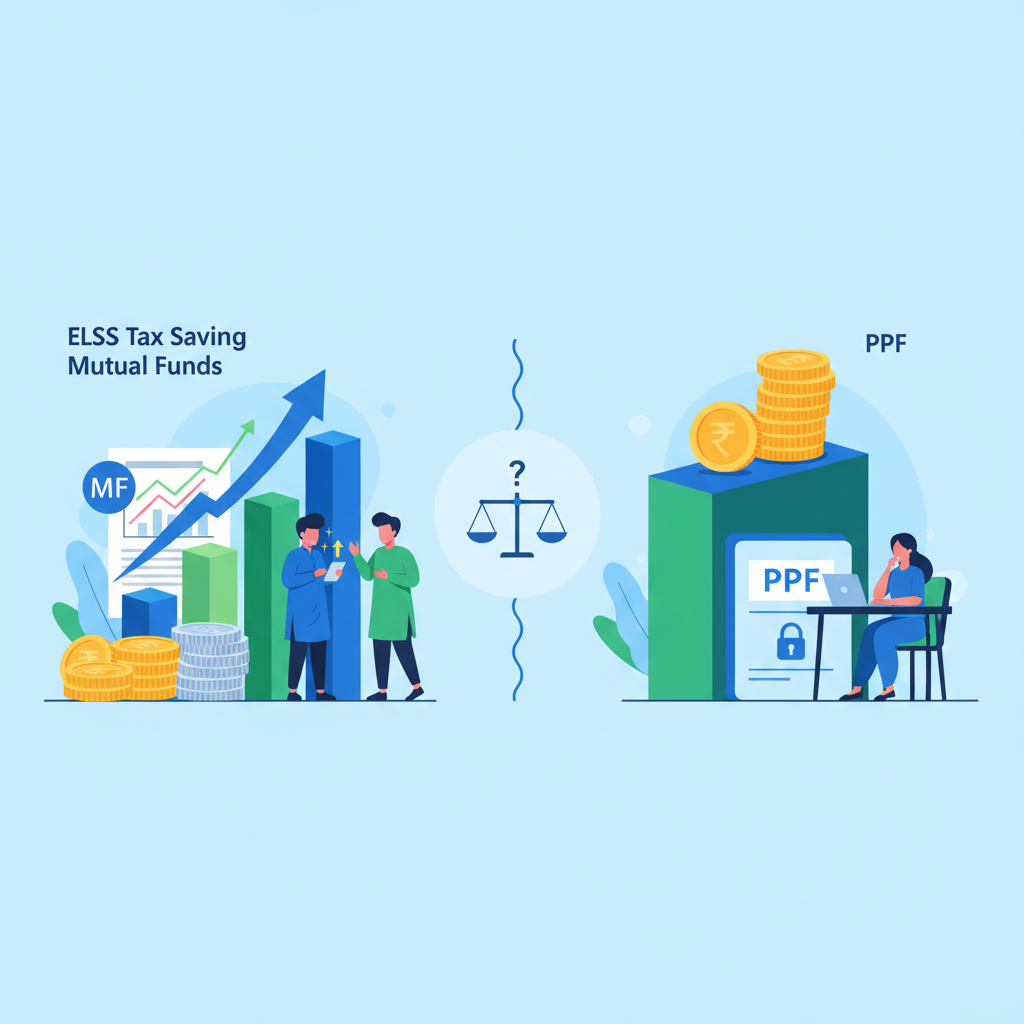
Alright, let’s talk about that dreaded tax season scramble. You’re Rahul, a software engineer in Bengaluru, earning ₹1.2 lakh a month. You’ve just gotten your Form 16, and boom, the tax man is coming for a chunk of your hard-earned money. Sound familiar? Every year, countless salaried professionals like you and me face the same question: how do I save tax under Section 80C effectively, without just blindly throwing money into whatever my uncle suggested?
Two big players always pop up in the conversation for tax saving: ELSS tax saving mutual funds and PPF. But which one is genuinely better for *you*? Not for some theoretical 'average person', but for your specific financial goals, risk appetite, and life stage. Honestly, most advisors will just give you a generic comparison. But as someone who’s spent 8+ years navigating these waters with folks just like you, I want to give you the real talk.
ELSS vs PPF: Understanding the Players on the Field
Before we pick a winner (or rather, figure out *your* winner), let's get clear on what we're actually comparing. Think of it like this: you're choosing between two vehicles to get you to the same destination (tax saving), but they offer very different rides.
ELSS (Equity Linked Savings Schemes): The Market Maverick
ELSS mutual funds are, simply put, equity funds that come with a tax benefit. When you invest in an ELSS fund, your money primarily goes into stocks. This means your investment is subject to market fluctuations – it can go up, and it can go down. The biggest selling point, beyond tax saving, is its potential for significant wealth creation over the long term. ELSS funds have the shortest lock-in period among all Section 80C instruments, at just 3 years. After these three years, your money is free to be redeemed or held further, as you wish. Profits from ELSS are subject to Long Term Capital Gains (LTCG) tax at 10% on gains exceeding ₹1 lakh in a financial year, after the 3-year lock-in.
PPF (Public Provident Fund): The Government-Backed Guardian
PPF is a government-backed, long-term savings scheme. It's a debt product, which means your returns are fixed by the government every quarter, not linked to the stock market. This makes it incredibly safe and predictable. The lock-in period for PPF is a significant 15 years, though partial withdrawals are allowed from the 7th financial year under specific conditions. The best part? The interest earned and the maturity amount are completely tax-free (E-E-E exempt). It's often seen as a cornerstone of conservative, long-term retirement planning for many, like Anita, a government employee in Pune who prioritizes safety above all else.
The Lock-in Period: How Soon Can You Touch Your Money?
This is where the rubber meets the road for many people. Imagine Priya from Hyderabad, earning ₹65,000 a month, saving for her child's higher education in 7-8 years. Or Vikram from Chennai, an experienced professional pulling in ₹1.5 lakh, looking at early retirement in 12 years. Their needs are vastly different, and the lock-in period is a critical factor.
ELSS: The Swift Exit (Relatively)
With ELSS, your funds are locked in for just 3 years. This is a game-changer. For example, if you start a SIP in an ELSS fund, each SIP installment gets locked in for 3 years from its respective investment date. Once that period is over, you have the flexibility to withdraw your money if you need it, or better yet, let it continue to grow. This shorter lock-in makes ELSS very attractive for those who might want access to their funds earlier for medium-term goals, or simply prefer not to have their money tied up for decades.
PPF: The Long Haul Commitment
PPF demands commitment – a 15-year commitment, to be precise. While partial withdrawals are permitted from the 7th year and loans can be taken against the balance from the 3rd year, you can't just take out your full amount whenever you want. This long lock-in period makes it ideal for true long-term goals like retirement, where you absolutely don't want to touch the corpus. If you have any doubt you might need the money sooner, PPF's rigid structure can be a disadvantage.
Returns & Risk: Where Your Money *Could* Grow Faster
This is often the most debated point. Everyone wants their money to grow, right? But how much risk are you willing to take for that growth? This is the fundamental difference between ELSS and PPF.
ELSS: The Growth Engine (with Market Risks)
Since ELSS invests primarily in equities, it offers the potential for significantly higher returns compared to debt-oriented products like PPF. Over the long term (say, 5-7 years and beyond), equity markets, as represented by benchmarks like the Nifty 50 or SENSEX, have historically delivered double-digit returns. For instance, many well-managed flexi-cap ELSS funds have shown historical average returns upwards of 12-15% annually over 5-10 year periods. Past performance is not indicative of future results. However, this higher return potential comes with higher risk – your investment value can fluctuate with market movements. There's no guarantee of returns, and you could see negative returns in the short term.
PPF: The Steady Pacer (Tax-Free & Guaranteed)
PPF offers a guaranteed interest rate, declared quarterly by the government. While this rate has fluctuated over the years (currently at 7.1% per annum), it has consistently provided stable, tax-free returns. This predictability is its greatest strength. You know exactly what you're getting, making it perfect for the risk-averse investor or for the debt portion of a well-diversified portfolio. For someone like Rahul, who might have market-linked investments elsewhere, PPF offers a crucial layer of safety and diversification.
Honestly, most advisors won't tell you this bluntly: if your goal is pure wealth creation with tax benefits, ELSS has a higher *potential* to outperform PPF significantly over the long haul. But if capital preservation and absolute safety are paramount, PPF is your champion.
Flexibility & Control: Tailoring to Your Financial Life
Beyond lock-ins and returns, how much control do you have over your investment journey?
ELSS: Your Investment, Your Rules (Mostly)
ELSS offers immense flexibility. You can invest via SIPs (Systematic Investment Plans) with amounts as low as ₹500, making it accessible to almost everyone. You can choose from a variety of ELSS funds managed by different AMCs (Asset Management Companies), each with a slightly different strategy. If you're unhappy with a fund's performance after the lock-in, you can switch to another. This ability to choose, monitor, and adapt your investments is a significant advantage, especially for someone who wants to actively manage their portfolio or learn about investing.
PPF: Government Guidelines, No Fund Manager Worries
PPF is far more rigid. You can invest a minimum of ₹500 and a maximum of ₹1.5 lakh in a financial year, either as a lump sum or in up to 12 installments. There's no 'fund manager' to pick; the government manages it. This simplicity is a boon for those who prefer a hands-off approach and don't want to bother with market analysis or fund selection. But it also means you have no control over the interest rate or the underlying investment strategy.
What Most People Miss About ELSS and PPF
Here’s what I’ve seen work for busy professionals and some common pitfalls:
- **The 'Only for Tax' Trap:** Many people dump money into ELSS in February or March just to save tax. This is a huge mistake! Investing lump sum at the last minute means you're exposed to market timing risk. Starting a monthly ELSS SIP at the beginning of the financial year (April) averages out your cost and lets you harness rupee-cost averaging. Don't let tax saving be your *only* motivation; view it as an opportunity for wealth creation.
- **Ignoring Diversification:** Thinking it's an 'either/or' scenario. For a truly robust financial plan, a mix of both debt (like PPF) and equity (like ELSS) is often the smartest play. PPF provides stability, while ELSS offers growth potential. This balanced approach hedges against various market conditions.
- **Underestimating PPF's 15-Year Lock-in:** While PPF is fantastic, 15 years is a long, long time. If you foresee any major expenses (house down payment, child's education) within that window, relying *solely* on PPF for your Section 80C might leave you short on liquidity.
- **Not Reviewing ELSS:** Just because the 3-year lock-in is over doesn't mean you *have* to redeem. Review your ELSS fund's performance annually, just like any other mutual fund. If it's performing well, let it continue to grow! If not, then consider switching.
Remember, Section 80C gives you a ₹1.5 lakh annual tax deduction limit. You don't have to fill it all with one instrument. A smart strategy often involves using a blend that suits your personal risk profile and financial goals.
FAQs: Your Burning Questions Answered
1. Can I invest in both ELSS and PPF simultaneously?
Absolutely, yes! Many savvy investors use both to maximize their tax benefits and diversify their portfolios. You can allocate your ₹1.5 lakh 80C limit across various instruments, including both ELSS and PPF. For instance, you could put ₹75,000 in PPF for safety and another ₹75,000 in ELSS for growth.
2. Is ELSS riskier than PPF?
Yes, unequivocally. ELSS funds invest in equities, meaning their value can fluctuate with market movements. PPF, being a government-backed debt instrument, offers guaranteed returns and capital protection, making it significantly less risky. The choice depends on your risk appetite.
3. What kind of returns can I expect from ELSS?
ELSS funds aim to generate returns by investing in the stock market. Historically, well-performing ELSS funds have offered potential returns in the range of 10-15% p.a. over long periods (5+ years). However, these are *potential* returns and not guaranteed. Past performance is not indicative of future results. Returns depend on market conditions and the fund's underlying performance.
4. What happens if I stop my ELSS SIP before the 3-year lock-in?
If you stop your ELSS SIP, the units already purchased will remain locked in for 3 years from their respective purchase dates. You cannot withdraw them before that. New investments simply won't be made. Your existing investment will continue to be subject to market fluctuations.
5. Is PPF entirely tax-free on maturity?
Yes, PPF follows the E-E-E (Exempt-Exempt-Exempt) tax model. The contributions you make are exempt from tax under Section 80C, the interest earned throughout the tenure is exempt from tax, and the maturity amount is also fully exempt from tax. This is a significant advantage for long-term wealth accumulation.
Your Next Step: Make an Informed Choice
So, which one is better for you? It's not a competition where one universally wins. It's about aligning your investment with *your* life. If you're younger, have a higher risk appetite, and are looking for aggressive wealth creation alongside tax benefits, ELSS is likely to be a better fit. If you're risk-averse, prefer guaranteed returns, and have a clear, long-term goal like retirement, PPF might be your go-to. And for many, a healthy blend of both, leveraging the strengths of each, is the smartest move.
Don't just invest to save tax; invest to build wealth. Take a moment to think about your goals and how much you can comfortably invest. A great way to visualize this is by using a SIP calculator. It can help you see the power of compounding for your ELSS investments over time. Check out a reliable one here: SIP Calculator.
Happy investing!
Mutual Fund investments are subject to market risks, read all scheme related documents carefully.