ELSS vs Non-Tax Saver Mutual Funds: SIP Calculator Comparison

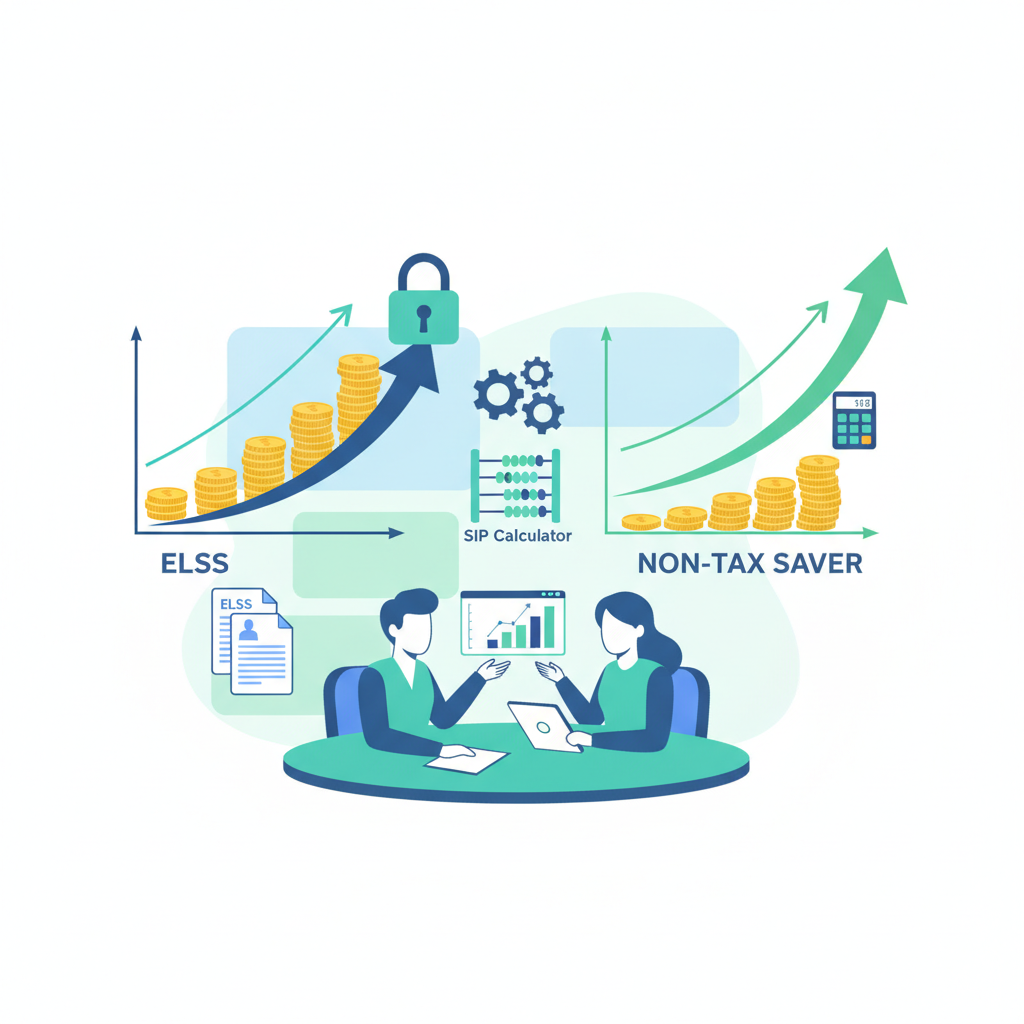
Siddharth sat staring at his office laptop on a rainy Tuesday afternoon in Bengaluru, his eyes darting between an urgent email from HR demanding tax proof submission and his bank account statement. At 29, earning a comfortable salary of ₹1.4 Lakhs a month, he realized he had procrastinated on his tax planning yet again. He had ₹15,000 a month to spare, but he was torn: should he lock it up in an Equity Linked Savings Scheme (ELSS) to save tax under Section 80C, or would he be better off building wealth in a flexible, unrestricted flexi-cap fund? To make an informed decision, he needed a detailed ELSS vs Non-Tax Saver Mutual Funds: SIP Calculator Comparison to see how his money would actually grow over the next decade.
The Silent Conflict of Locked vs Free Capital
Many salaried professionals face this exact dilemma every year. We are conditioned to treat tax saving as a frantic, year-end chore rather than an integral part of our broader asset allocation. The primary confusion stems from comparing ELSS and non-tax-saving mutual funds solely on their historical returns, without factoring in tax regimes, liquidity constraints, and long-term portfolio flexibility. When you commit to a monthly SIP in an ELSS, you are not just signing up for equity exposure; you are committing to a rolling three-year lock-in period. Every single monthly installment you make is locked for exactly 36 months from the date of its purchase. This is a massive distinction that standard calculators often glaze over.
In my experience with salaried professionals who rush into ELSS at the last minute, they often forget that liquidity has its own premium. If you lock your capital, you lose the ability to rebalance your portfolio during market extremes. If valuations stretch to uncomfortable highs, you cannot move your ELSS corpus into a balanced advantage fund or a liquid fund to shield your gains. On the flip side, non-tax-saving mutual funds, such as flexi-cap or large-cap index funds, grant you the absolute freedom to exit whenever you please, albeit at the cost of giving up the upfront tax deduction under Section 80C of the Income Tax Act.
This decision has become even more layered with the introduction and subsequent sweetening of the New Tax Regime. For those who have switched over to the New Tax Regime, the ₹1.5 Lakh deduction under Section 80C is completely unavailable. Investing in an ELSS under the New Tax Regime means you get all of the lock-in constraints with absolutely none of the tax-saving benefits. It is a mathematical misstep that quietly erodes your financial flexibility.
ELSS vs Non-Tax Saver Mutual Funds: SIP Calculator Comparison and the Math of Compounding
To truly understand how these two categories stack up, let us examine the numbers. Let us look at a scenario where you invest ₹10,000 monthly through a systematic investment plan. According to recent AMFI data, monthly SIP contributions in India have scaled to record highs, surpassing ₹25,000 crore, indicating that lakhs of salaried professionals are automating their wealth-building journey. But what happens to that monthly SIP over a 10-year horizon in an ELSS versus an open-ended flexi-cap fund?
Suppose both funds grow at an estimated annual return of 12%. Past performance is not indicative of future results. If you perform a flat SIP calculation, the mathematical output is identical. A ₹10,000 monthly SIP over 10 years (total investment of ₹12 Lakhs) at a 12% estimated annual return yields a future value of approximately ₹23.23 Lakhs. But this is where standard comparisons fall short because they do not account for the tax saved upfront and the tax paid on maturity.
Under the Old Tax Regime, if you fall in the 30% tax bracket, investing ₹1.2 Lakhs annually in an ELSS saves you ₹39,000 in taxes each year (including 4% cess). If you take that saved tax of ₹3,250 every month and reinvest it into an open-ended fund, your net monthly investment effectively increases without denting your take-home pay. This is the compound effect of tax reinvestment. By utilizing an ELSS vs Non-Tax Saver Mutual Funds: SIP Calculator Comparison that integrates tax-back reinvestment, the financial picture shifts dramatically. You are no longer just comparing ₹10,000 vs ₹10,000; you are comparing ₹10,000 in a non-tax saver against an effective ₹13,250 total allocation enabled by your tax savings.
Let us break down the mathematical formula for a Step-Up SIP, which is how actual salaried professionals grow their investments as their annual CTC increases. Unlike a flat SIP where the contribution remains constant, a Step-Up SIP increases the monthly contribution by a fixed percentage annually (e.g., 10% step-up). The future value of a Step-Up SIP is calculated using a recursive compounding formula where each year's monthly payment $P_y$ increases:
P_y = P_1 * (1 + g)^(y-1)
Where g is the annual step-up rate, and y is the current year. Compounding is then applied to these escalating cash flows monthly. When you use a step-up model over 15 years, the difference between a flat SIP and an escalating SIP can mean a difference of lakhs of rupees in your final retirement nest egg.
Designing Your Portfolio: A Step-by-Step Tactical Plan
You do not need to choose blindly between these two paths. A structured approach ensures your monthly savings are optimized for both immediate tax efficiency and long-term goal alignment. Here is a step-by-step strategy to allocate your hard-earned salary.
- Step 1: Identify Your Active Tax Regime. Review your tax declaration. If you are under the New Tax Regime, skip ELSS entirely. Your focus should be purely on open-ended, non-tax saver funds like flexi-cap, large-cap index, or mid-cap funds depending on your risk appetite.
- Step 2: Calculate Your 80C Gap. If you are under the Old Tax Regime, do not automatically dump ₹1.5 Lakhs into ELSS. First, deduct your mandatory contributions such as Employee Provident Fund (EPF), Public Provident Fund (PPF), school fees, and life insurance premiums. If these total ₹90,000, your remaining gap to maximize Section 80C is only ₹60,000.
- Step 3: Cap Your ELSS SIP. Based on the remaining gap from Step 2, set your ELSS SIP. If your gap is ₹60,000, your monthly ELSS SIP should be exactly ₹5,000. Any investable surplus beyond this ₹5,000 should bypass ELSS completely and flow into non-tax-saving categories.
- Step 4: Automate and Step Up. Set up your systematic investment plans to auto-debit on the day after your salary credit. Ensure you configure an annual step-up of at least 10% on your non-tax-saving SIPs to match your yearly salary increments and outpace lifestyle inflation.
The Advanced Angle: Tax Drag and the Cost of Locked Liquidity
What most financial portals fail to highlight is the structural tax drag and the strategic limitations of ELSS as your portfolio grows. When you invest in a non-tax-saving mutual fund, you retain the freedom to practice tax-harvesting. You can redeem up to ₹1.25 Lakhs of long-term capital gains (LTCG) tax-free every single financial year (as per current tax laws) and reinvest it immediately, effectively resetting your cost acquisition base. With ELSS, your capital is locked tight for three years, meaning you cannot touch those units to harvest gains or rebalance your portfolio, even if the market is screamingly overvalued.
Consider the sequence of returns risk. Imagine a scenario where the equity market enters a prolonged bear phase exactly at the end of your three-year lock-in period. In an open-ended fund, you could have systematically moved your corpus into safer liquid or arbitrage funds a year in advance to secure your goals. In an ELSS, you are forced to watch your locked-in units swing with the market volatility, unable to take preventive action. This lack of maneuverability is a hidden cost that should be factored into your allocation strategy.
Common Pitfalls Salaried Minds Fall Into
The most frequent error is treating ELSS as a short-term three-year deposit. Salaried professionals often stop their SIPs after three years and withdraw the entire amount to fund a vacation or buy a vehicle. Equity investments require a seven-to-ten-year horizon to smooth out market cycles. Withdrawing your ELSS funds the moment they unlock defeats the purpose of compounding and treats a high-growth equity asset like a basic savings account.
Another common mistake is collecting a massive laundry list of ELSS funds. Because people select a new fund every January based on that year's star ratings, they end up holding five or six different ELSS schemes after a few years. This does not offer diversification; it creates portfolio clutter and stock overlap, making it incredibly tedious to track performance and manage redemptions. You only ever need one, or at most two, solid ELSS funds to manage your tax-saving equity allocation.
Finally, there is the trap of ignoring the expense ratio. Because ELSS funds are often sold actively under the guise of tax-saving miracles, some carry higher expense ratios than their equivalent flexi-cap or large-cap index counterparts. Over a 15-to-20-year horizon, a 0.5% difference in the expense ratio can eat away lakhs from your potential compounding pool. Always look for direct plans instead of regular plans to keep your expenses to an absolute minimum.
Mapping Your Future Wealth
Are you maximizing your hard-earned money, or are you letting tax anxiety dictate your investment choices? Striking the right balance between locked tax-savers and liquid wealth-builders is the key to stress-free financial planning. To model your own custom scenarios, run your monthly savings numbers through our interactive ELSS SIP tax benefit maximizer to see exactly how much you stand to accumulate over your working years.
Mutual Fund investments are subject to market risks. This article is for educational and informational purposes only and does not constitute financial advice. Please read all scheme-related documents carefully and consult a SEBI-registered investment advisor before investing.