ELSS vs Tax Saving FD: Which is Better for Section 80C? | SIP Calculator

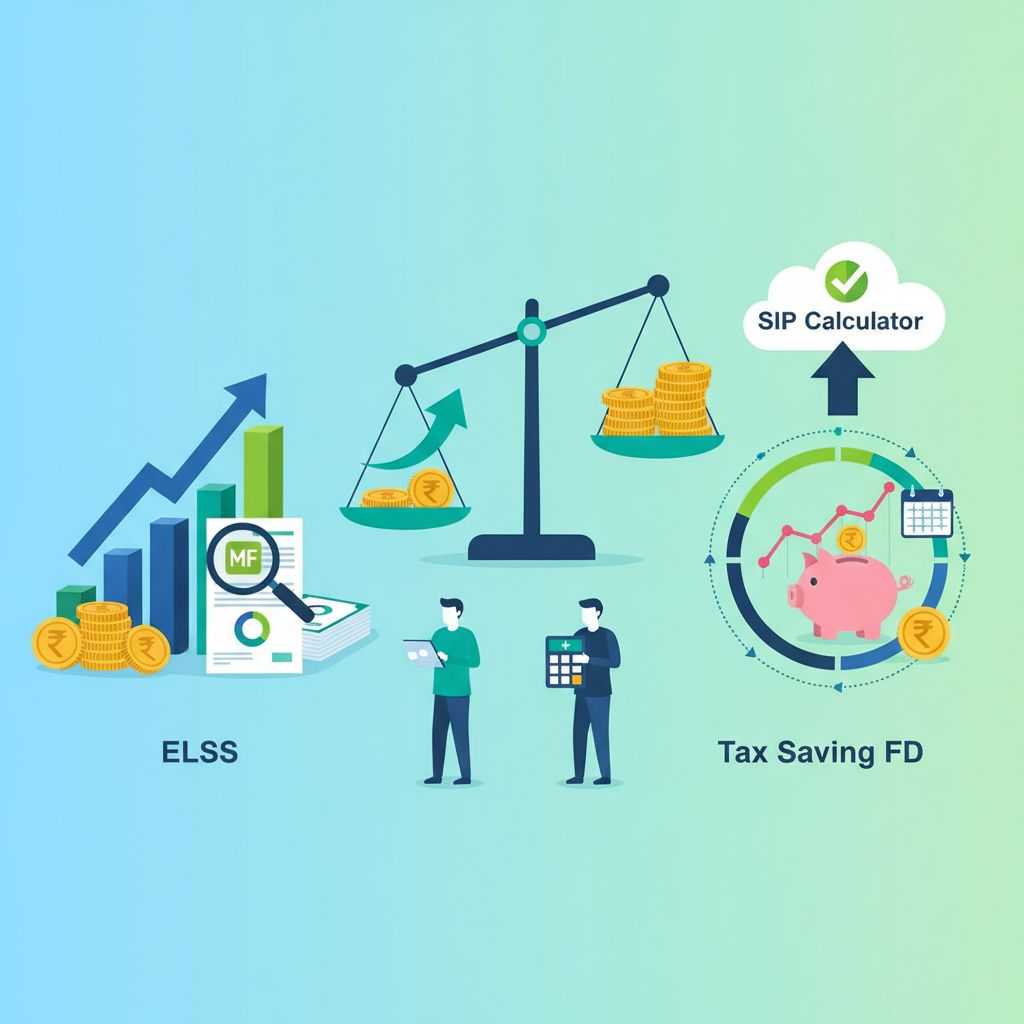
It was a chaotic Tuesday afternoon in early March when Arjun, a 29-year-old software engineer working at a tech firm in Bengaluru, realized he had a major financial leak. Making a comfortable ₹1.2 Lakhs a month, he was staring at his office portal's investment declaration deadline. Like many young professionals, Arjun had procrastinated. To avoid a massive tax deduction from his salary, he did what he had always done: he logged into his net banking portal and booked a ₹1.5 Lakh Tax Saving Fixed Deposit (FD) in under five minutes. He uploaded the receipt, breathed a sigh of relief, and forgot about it. It was only three years later, when he sat down to evaluate his net worth, that he realized his hasty decision had locked his hard-earned money into a low-yielding asset that was barely keeping pace with inflation. Arjun had fallen into the classic trap of ignoring how tax drag and inflation quietly erode wealth over time.
The Core Problem: ELSS vs Tax Saving FD: Which is Better for Section 80C?
For salaried professionals in India, Section 80C of the Income Tax Act is both a blessing and a puzzle. It allows you to deduct up to ₹1.5 Lakhs from your taxable income, saving you up to ₹46,800 annually if you fall in the highest 30% tax bracket. But the financial services industry has created an overwhelming array of products to capture this money. Among the most popular choices are the traditional Tax Saving Fixed Deposit (FD) and the Equity Linked Savings Scheme (ELSS), a specialized category of mutual funds.
Why do so many smart professionals get this choice wrong? The primary reason is a fundamental misunderstanding of risk and liquidity. A Tax Saving FD offers the comforting illusion of safety with its guaranteed returns and predictable maturity values. However, it locks your money away for a strict five-year period, and the interest earned is taxed at your slab rate. On the flip side, ELSS mutual funds offer exposure to Indian equities with a significantly shorter three-year lock-in period. Because they invest in the stock market, their returns fluctuate, which scares away conservative savers. To make an informed decision on ELSS vs Tax Saving FD: Which is Better for Section 80C?, we must look past the superficial features and analyze the raw math behind their actual wealth-generating potential.
The Math Behind the Choices: Capital Growth vs Tax Drag
To understand how these two instruments compare, we need to look at how inflation and taxes impact your final corpus. Let us analyze a practical scenario. Suppose you invest ₹1,50,000 under Section 80C today. Arjun is in the 30% tax bracket (which, including cess, works out to 31.2%). Let us compare a 5-year Tax Saving FD offering a 7% per annum interest rate against an ELSS fund that historically delivers an estimated 12% annual return.
With the Tax Saving FD, your ₹1,50,000 earns interest every year, but that interest is added to your income and taxed at 31.2% annually. This is known as tax drag. Your effective post-tax yield drops from 7% to a meager 4.82%. After 5 years, your ₹1,50,000 grows to approximately ₹1,90,147.
Now let us look at the ELSS route. Under SEBI's strict categorization, ELSS funds must invest at least 80% of their assets in equity and equity-related instruments. Over a 5-year horizon, the power of compounding in the stock market can be highly effective. If we assume a conservative 12% annual growth rate, your ₹1,50,000 grows to ₹2,64,351 over the same 5 years. (Past performance is not indicative of future results.)
What about taxes? ELSS returns are classified as Equity Long-Term Capital Gains (LTCG). Currently, LTCG on equity mutual funds is tax-free up to ₹1.25 Lakhs per financial year across all your equity investments. Gains exceeding ₹1.25 Lakhs are taxed at a flat 12.5%. In Arjun's case, his total profit of ₹1,14,351 is entirely tax-free because it falls below the ₹1.25 Lakh annual threshold. Even if he exceeded the threshold, the tax rate of 12.5% is vastly superior to his 31.2% income tax slab rate on FD interest. Here is how the final numbers compare:
| Parameter | Tax Saving Fixed Deposit (FD) | ELSS Mutual Fund (Estimated) |
|---|---|---|
| Investment Amount | ₹1,50,000 | ₹1,50,000 |
| Lock-in Period | 5 Years | 3 Years |
| Assumed Rate of Return | 7.0% p.a. | 12.0% p.a. (Estimated) |
| Taxability of Returns | Taxed annually at slab rate (e.g., 31.2%) | LTCG taxed at 12.5% (gains up to ₹1.25L free) |
| Net Maturity Value (5 Yrs) | ₹1,90,147 | ₹2,64,351 |
| Real Post-Tax Return | ~4.82% | ~12.0% (Assuming zero active LTCG tax) |
When you account for inflation, which the Reserve Bank of India (RBI) historically targets around 4% to 6%, Arjun's Tax Saving FD is actually yielding a near-zero or negative real rate of return. One thing I’ve noticed in my years researching and writing about personal finance is that salaried professionals often celebrate saving ₹46,800 in taxes today, while completely ignoring that they are locking their capital into an instrument that slowly loses its purchasing power over the next five years.
Strategic Tax Planning: Moving Away From the March Madness
If you want to maximize your returns while minimizing risk, you must abandon the habit of lumpsum investing at the end of the financial year. The most effective way to invest in an ELSS is through a Systematic Investment Plan (SIP). A monthly SIP allows you to rupee-cost average your investments. This means you buy more units when the stock market is down and fewer units when it is up, smoothing out market volatility over time.
According to data published monthly by the Association of Mutual Funds in India (AMFI), monthly SIP contributions in India have consistently scaled new heights, crossing ₹20,000 crores as retail investors realize the power of systematic wealth building. By breaking down your ₹1.5 Lakh 80C limit into a disciplined monthly SIP of ₹12,500, you avoid the cash crunch that happens in March. More importantly, your money is put to work in the market systematically throughout the year instead of being timed arbitrarily at the end of the fiscal cycle.
Before allocating your entire ₹1.5 Lakhs to an ELSS SIP, however, you must perform a quick diagnostic check on your salary slip. If you are a salaried professional, you are likely already contributing to the Employees' Provident Fund (EPF). Your annual EPF contribution also counts toward the ₹1.5 Lakh Section 80C limit. For example, if your EPF contribution is ₹60,000 a year, you only need to invest ₹90,000 in ELSS to maximize your tax benefits. This translates to a highly manageable monthly SIP of ₹7,500.
The Advanced Angle: The Lock-In Trap Most Investors Miss
While ELSS has a shorter 3-year lock-in period compared to the 5-year lock-in of a Tax Saving FD, there is a technicality that catches many monthly SIP investors off guard. It is what I call the "rolling lock-in trap."
When you invest in a Tax Saving FD via a lump sum, the entire amount matures at the end of 5 years. However, when you invest in an ELSS through a monthly SIP, each individual monthly installment is treated as a unique investment with its own distinct 3-year lock-in period. For instance, the SIP installment you pay on April 1, 2024, will unlock on April 1, 2027. But the installment you pay on May 1, 2024, will only unlock on May 1, 2027. If you decide to stop your SIP after 36 months, you cannot withdraw your entire accumulated corpus at once; you will have to withdraw it month-by-month as each systematic investment completes its respective 3-year holding period.
This structural nuance is why you should never treat ELSS as a short-term, 3-year vehicle. Even though the legal lock-in is 3 years, equities perform best over a horizon of 5 to 7 years. In my experience with readers who panicked during market downturns, those who treated ELSS as a long-term compounder fared vastly better than those who tried to pull their money out the exact day their 3-year lock-in expired. Think of ELSS not just as a tax-saving tool, but as a diversified equity portfolio—akin to a flexi-cap or multi-cap fund—that comes with a temporary lock-in which actually prevents you from making emotional, panic-driven redemptions during market corrections.
Common Mistakes Salaried Professionals Make
The first major error is investing in multiple ELSS funds simultaneously. I have seen portfolios containing four or five different ELSS schemes. This does not offer better diversification. Because most ELSS funds invest across large, mid, and small-cap stocks, owning multiple funds simply leads to portfolio overlap and high expense ratios without adding any real performance benefit. One well-chosen ELSS fund is more than enough to manage your Section 80C equity exposure.
Another common blunder is failing to assess your overall asset allocation. If you are already putting a massive portion of your savings into debt instruments like EPF, Public Provident Fund (PPF), and traditional insurance policies, opting for a Tax Saving FD further skews your asset allocation toward low-yielding debt. For a young professional with decades of earning potential ahead, this asset mismatch can delay financial independence by years. Conversely, if you have no debt cushion at all, dumping all your money into equities without understanding your risk tolerance can lead to sleepless nights during market corrections.
Finally, avoid treating your bank's relationship manager as your unbiased financial advisor. Banks have aggressive targets to sell their in-house Tax Saving FDs or regular mutual fund schemes that carry high commissions. They rarely explain the long-term tax drag of FDs or the rolling lock-in structure of ELSS SIPs. Always do your own research and rely on transparent data to make your investment choices.
Map Your Journey with the Right Tool
Understanding the theoretical difference between these assets is step one, but seeing how your monthly investments compound over time is what truly builds conviction. Before you commit your hard-earned money to a specific tax-saving route, you should run your own customized numbers. You can model your potential growth, compare systematic scenarios, and build a highly structured investment plan using the interactive ELSS SIP tax benefit maximizer. By visualizing how systematic contributions grow while reducing your tax liability, you can transition from reactive, last-minute March tax planning to a proactive, wealth-building strategy that aligns perfectly with your long-term financial goals.
Mutual Fund investments are subject to market risks. This article is for educational and informational purposes only and does not constitute financial advice. Please read all scheme-related documents carefully and consult a SEBI-registered investment advisor before investing.