First-Time Investor: Lumpsum Investment vs SIP for Higher Returns?

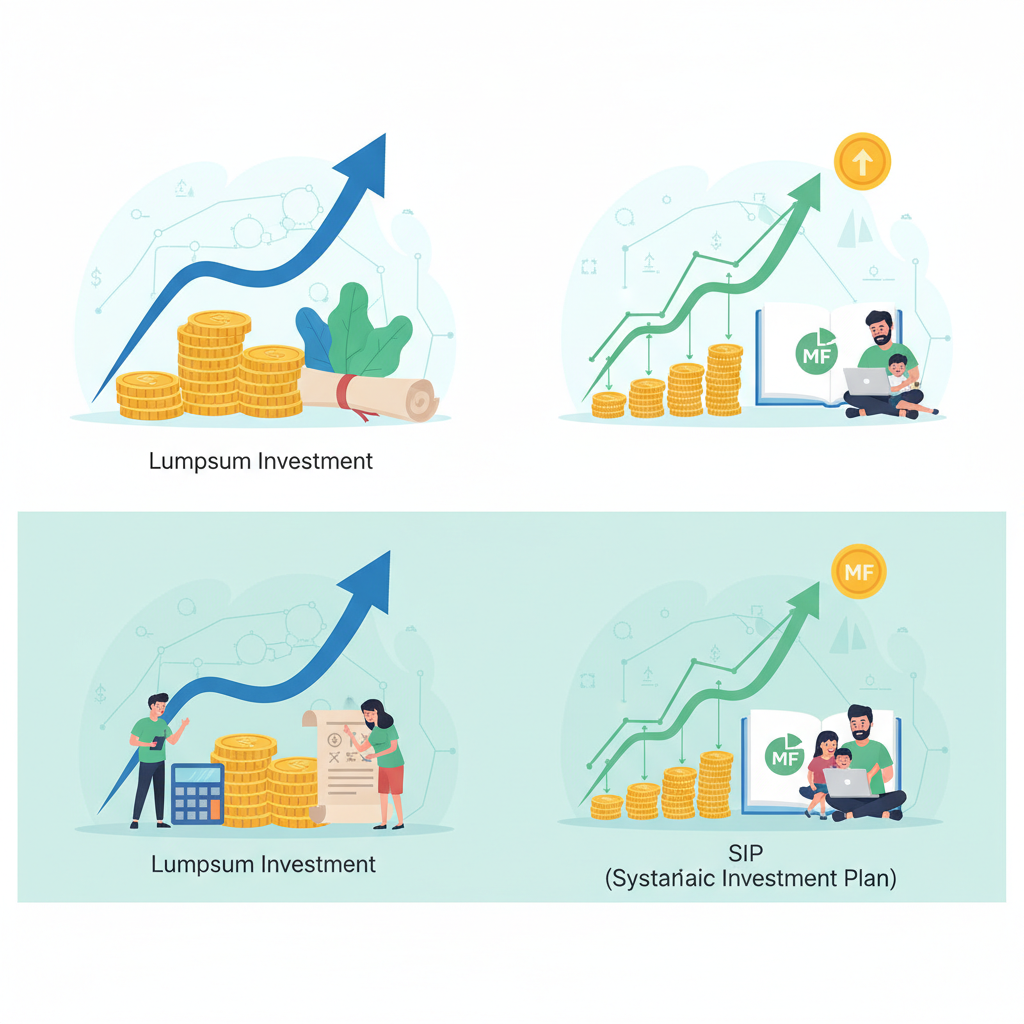
Alright, so you’ve got some savings, maybe a decent bonus from work, or you’ve just decided it’s high time to make your money work harder for you. You’re a first-time investor, looking at mutual funds, and suddenly you’re hit with a fundamental question: Should I put all my money in at once (lumpsum) or invest smaller amounts regularly (SIP)? This dilemma, the classic First-Time Investor: Lumpsum Investment vs SIP for Higher Returns? question, is one I hear all the time from folks like you in Pune, Hyderabad, Chennai, and Bengaluru.
Honestly, it’s one of the biggest mental blocks new investors face. You're told to invest for the long term, but how you *start* often feels just as important. Let’s cut through the jargon and figure out what makes sense for someone just dipping their toes into the market.
Lumpsum Investing: The Big Splash and Its High Tide Risks
Think of a lumpsum investment as taking all your accumulated savings – say, that ₹2 lakh bonus you got, or the ₹5 lakh you saved up over a year – and putting it into a mutual fund scheme in one go. It’s a single, significant transaction. The logic here is simple: if the market goes up right after you invest, you’re looking pretty smart, pretty fast.
For instance, Vikram, an IT professional from Bengaluru earning ₹1.2 lakh a month, recently sold a small ancestral plot for ₹8 lakhs. He’s thinking, “Boom! I’ll put it all into a Nifty 50 Index Fund and hopefully ride the bull market.” Now, if Vikram had invested that ₹8 lakhs right before a major market rally, he’d likely see some fantastic potential returns quickly. Historically, if you manage to time the market perfectly, a lumpsum investment can deliver higher returns than a SIP over the same period. But here’s the kicker:
Can you, or anyone for that matter, reliably time the market? Predicting market highs and lows consistently is a fool's errand, even for seasoned pros. What if Vikram invests his ₹8 lakhs, and the very next week, the market corrects by 10%? Suddenly, his ₹8 lakhs is worth ₹7.2 lakhs, and he’s feeling a knot in his stomach. This is the biggest risk with lumpsum investing for a first-timer: the emotional rollercoaster of market timing. It can be incredibly stressful and might even make you quit investing altogether if your first experience is a downward trend. Remember, past performance is not indicative of future results.
SIP: Your Steady Partner in Wealth Building
Now, let's talk about SIP, the Systematic Investment Plan. This is where you commit to investing a fixed amount – say, ₹5,000 or ₹10,000 – at regular intervals, typically monthly, into a chosen mutual fund scheme. It's like paying a recurring bill, but instead of spending, you're investing.
Priya, a newly salaried professional in Pune earning ₹65,000 a month, decides to start a ₹7,500 monthly SIP in a Flexi-Cap Fund. She doesn't have a huge lumpsum, but she has a steady income. Every month, her ₹7,500 goes into the fund. When the market is high, her SIP buys fewer units. When the market is low, the same ₹7,500 buys more units. Over time, this averages out her purchase cost, a concept famously known as Rupee Cost Averaging. It takes the stress out of market timing completely.
This systematic approach is exactly why AMFI (Association of Mutual Funds in India) and SEBI (Securities and Exchange Board of India) advocate for disciplined investing. It’s not about hitting a home run; it’s about consistently getting on base and accumulating runs over time. For someone like Priya, who's building wealth from scratch, a SIP is a game-changer. It instills financial discipline, allows you to start small, and leverages the power of compounding without forcing you to make nerve-wracking timing decisions.
Deciding Between Lumpsum and SIP for Higher Returns: What Data Really Says
Many first-time investors get hung up on which method historically gives “higher returns.” The truth is, for most people, especially those just starting out, SIP often proves to be the superior choice, not necessarily because it *always* generates higher absolute returns than a perfectly timed lumpsum (which it might not), but because it dramatically reduces risk and emotional turmoil. And that, my friend, is priceless.
Imagine Anita from Chennai, saving for her children’s higher education in 15 years. Her goal isn't to make a quick buck; it's to build a substantial corpus reliably. A SIP allows her to consistently invest in a diversified fund, say a Balanced Advantage Fund, which adjusts its equity-debt allocation based on market conditions, and gradually build wealth without worrying about market dips every other month. Over long periods, Indian equity markets (represented by indices like the Nifty 50 or SENSEX) have shown potential for decent returns, but these returns are best captured by staying invested through market cycles, which SIP helps you do naturally.
Here’s what I’ve seen work for busy professionals over my 8+ years: Consistency beats trying to be a market guru. For a first-time investor, trying to perfectly time a lumpsum can lead to anxiety and premature exits from investments, which is a sure-fire way to stunt your wealth growth. SIP, on the other hand, makes investing almost automatic, letting you focus on your career and life, while your money quietly works in the background. It truly is the easier path for long-term wealth creation for the vast majority of people.
What Most People Get Wrong as a First-Time Investor
- Believing they can time the market: This is probably the biggest blunder. Even experienced fund managers struggle with consistent market timing. For a beginner to attempt it with their first significant investment is often a recipe for disappointment.
- Stopping SIPs during market corrections: This is where SIPs truly shine! When the market falls, your fixed SIP amount buys *more* units. Stopping means you miss out on buying low, which is crucial for Rupee Cost Averaging.
- Not matching investments to goals: Investing without a clear purpose (retirement, child's education, house down payment) often leads to impulsive decisions.
- Ignoring the power of a SIP Step-Up: As your salary increases (e.g., Rahul from Hyderabad, whose ₹1.2 lakh/month income gives him more disposable income), you should increase your SIP amount. This simple act can dramatically boost your long-term corpus. You can use a SIP step-up calculator to see this magic for yourself.
- Getting swayed by 'hot tips': Friends, family, or online forums giving unsolicited advice on a particular fund, often based on short-term performance, can be dangerous. Always do your own research or consult a SEBI-registered investment advisor.
Frequently Asked Questions About Lumpsum vs SIP for Beginners
Got more questions swirling in your head? You're not alone. Here are some common ones:
Is a lumpsum investment always riskier than a SIP?
For a first-time investor, yes, generally. The primary risk of a lumpsum is timing. If you invest just before a market downturn, your initial investment could see an immediate, significant dip, which can be emotionally challenging. A SIP, through Rupee Cost Averaging, smooths out this risk over time.
Can I do both lumpsum and SIP?
Absolutely! This is often a smart strategy for someone who has a significant sum of money (like Vikram's ₹8 lakhs from the plot sale) but also wants the discipline of regular investing. You could invest a portion as a lumpsum (if you're confident about market conditions or have a very long horizon) and then start a regular SIP with your monthly savings. Or, even better, if you have a large sum, consider a Systematic Transfer Plan (STP) where you put the lumpsum into a liquid fund and then transfer fixed amounts to an equity fund via SIP. This gives you the best of both worlds – your money is working, and you’re still averaging costs.
How much should a first-time investor put into SIP?
Start with an amount you are comfortable committing to every month without fail. Even a small amount like ₹500 or ₹1,000 can kickstart your journey. The key is consistency. As your income grows, gradually increase your SIP amount. A good thumb rule is to aim for at least 10-15% of your take-home salary, but even 5% is a great start. The important thing is to just begin.
What mutual fund category is best for beginners?
For most first-time investors looking for long-term growth, a Flexi-Cap Fund or a Multi-Cap Fund is often a good starting point. These funds invest across market capitalizations (large, mid, and small cap companies) and sectors, offering diversification. Balanced Advantage Funds are also excellent for beginners as they manage equity-debt allocation dynamically, reducing volatility. However, always remember to consider your own risk tolerance and financial goals.
What if I have a large sum now, but also want to invest regularly?
As mentioned before, an STP (Systematic Transfer Plan) is your friend here. You invest your large sum into a relatively low-risk fund (like a liquid fund or ultra short-duration fund) and then set up automatic transfers of a fixed amount monthly into your chosen equity mutual fund. This way, your large sum earns some returns while awaiting deployment, and you still benefit from rupee cost averaging. It's a fantastic bridge between having a lumpsum and wanting to invest systematically.
My Takeaway for You: Just Start, and Start Smart!
If you're a first-time investor, feeling overwhelmed by the choice between lumpsum and SIP, my advice is simple: lean heavily towards SIP. It's about building a solid, disciplined habit, reducing risk, and harnessing the power of compounding without the headache of market timing. It’s what helps ordinary salaried professionals like you become extraordinary wealth creators.
Don't wait for the 'perfect' market condition. There isn't one. The best time to invest was yesterday; the next best time is today. Start your SIP, stay consistent, and watch your wealth grow over time. Want to see how much your monthly SIP could grow to? Play around with a SIP calculator – it’s a real eye-opener!
This blog post is for educational and informational purposes only. This is not financial advice or a recommendation to buy or sell any specific mutual fund scheme.
Mutual Fund investments are subject to market risks, read all scheme related documents carefully.