How Much SIP to Retire at 55 with ₹1 Lakh/Month Income?

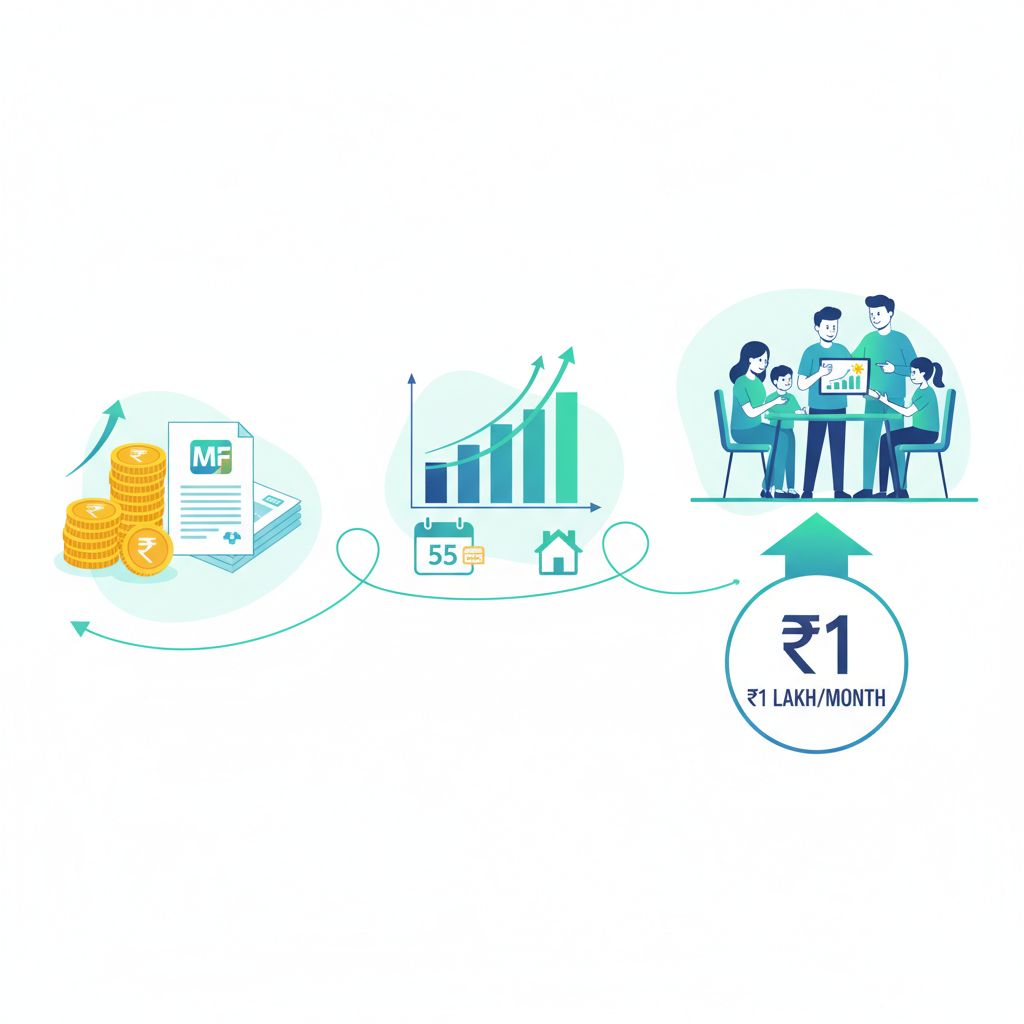
Ever dreamt of packing your bags, leaving the corporate grind behind, and truly living life on your own terms by 55? What if I told you that dreaming of a ₹1 Lakh/month income in retirement isn't just a pipe dream for us salaried professionals in India? It’s absolutely achievable with a smart, consistent SIP strategy. I’ve been advising folks like you for over eight years, from the bustling streets of Bengaluru to the quieter corners of Pune, and I’ve seen this dream turn into reality for many.
Most of us, in our 20s and 30s, get caught up in the daily hustle. We’re thinking about EMIs, rent, maybe a new car, or that next foreign trip. Retirement often feels like a distant, fuzzy picture. But trust me, the earlier you start planning for that comfortable retirement at 55, the less stress you’ll have later. Let’s break down exactly how much SIP you might need to build that golden nest egg.
The Real Cost of Retiring at 55 with a ₹1 Lakh/Month Income (Today's Value)
Here’s the thing about money: it doesn't stay the same. ₹1 Lakh today won’t buy you the same things 20 or 25 years from now. Inflation, my friend, is a silent wealth killer if you don't account for it. Imagine Priya, a 30-year-old software engineer in Chennai, currently earning ₹1.2 lakh/month. She wants to retire at 55, enjoying an equivalent of ₹1 lakh/month income in today's terms. That’s 25 years from now.
Let's assume a conservative average inflation rate of 6% per annum in India. After 25 years, that ₹1 lakh/month she desires will actually need to be around ₹4.30 lakh/month just to have the same purchasing power!
So, Priya's actual target monthly income at retirement isn't ₹1 lakh, but ₹4.30 lakh per month. To sustain this for 25-30 years in retirement (assuming an average life expectancy), you need a substantial corpus. A common thumb rule is to aim for a corpus that is 25 times your annual expenses. If Priya needs ₹4.30 lakh/month, her annual expense would be ₹51.60 lakh. Multiply that by 25, and her target retirement corpus is a whopping ₹12.9 Crore!
Sounds intimidating, right? Don't fret. This is where the magic of compounding through SIPs truly shines.
Unpacking the Numbers: Your SIP to Retire at 55 Calculation
Now that we know the target corpus (let’s stick with ₹12.9 Crore for Priya), let's talk about the SIP. How much do you need to invest monthly to get there? This depends heavily on your investment horizon (how many years you have) and the expected returns from your mutual fund investments.
For long-term goals like retirement, equity mutual funds are generally the preferred choice due to their potential to beat inflation and generate significant wealth. Historically, diversified equity mutual funds have delivered average annual returns in the range of 10-14% over extended periods. Remember, past performance is not indicative of future results, but it gives us a good estimate for planning.
Let's assume an average annual return of 12% for our calculations.
If Priya starts a fixed SIP today (at age 30) for 25 years to accumulate ₹12.9 Crore, she would need to invest approximately ₹1,00,000 every single month. For many, a fixed SIP of ₹1 Lakh right off the bat might seem steep.
Here’s what I’ve seen work for busy professionals like Rahul, a 35-year-old manager in Hyderabad. He knew a fixed SIP might not cut it, so he embraced the concept of a Step-Up SIP. This means increasing your SIP amount by a certain percentage each year, typically in line with your salary increments. This strategy is a game-changer!
If Rahul (or Priya) starts with a more manageable SIP of, say, ₹25,000 per month and increases it by 10% annually (a reasonable expectation with regular increments), here’s a rough estimate:
- Initial SIP: ₹25,000/month
- Annual Step-up: 10%
- Investment Horizon: 25 years (until age 55)
- Expected Annual Return: 12%
With this approach, Rahul could potentially accumulate a corpus of approximately ₹10-11 Crore. This is closer to our target ₹12.9 Crore, and with a slightly higher starting SIP or step-up percentage, he could easily bridge the gap.
Honestly, most advisors won’t tell you this, but the power of a step-up SIP is often underestimated. It makes large retirement goals far more achievable. You can play around with different scenarios yourself using a SIP Step-Up Calculator – it's an incredibly useful tool for visualizing your financial journey.
Building Your Retirement War Chest: Choosing the Right Mutual Funds
So, you’re ready to start your SIP, but where do you put your money? With hundreds of mutual funds out there, it can feel overwhelming. Don't worry, it's simpler than you think.
For a long-term goal like retirement (20+ years), your portfolio should heavily lean towards equity mutual funds. Why? Because they offer the best chance for significant capital appreciation over such a long horizon. Think about it: the Nifty 50 and SENSEX have shown remarkable growth over decades, despite short-term market fluctuations.
Here are a few categories I often recommend for core retirement portfolios:
- Flexi-Cap Funds: These funds offer fund managers the flexibility to invest across market capitalizations (large-cap, mid-cap, small-cap) based on their view of market conditions. This adaptability can be a big advantage.
- Large-Cap Funds: For stability and consistent growth, large-cap funds investing in established companies are a solid choice.
- Index Funds: If you prefer simplicity and low costs, Nifty 50 or Nifty Next 50 index funds are excellent options. They simply track the underlying index, offering market-linked returns. They remove the fund manager's active decision-making bias.
- ELSS (Equity Linked Savings Schemes): While primarily tax-saving instruments with a 3-year lock-in, ELSS funds are also equity-oriented and can contribute to your long-term wealth creation, especially if you're looking to save tax under Section 80C alongside your primary retirement SIPs.
As you get closer to retirement (say, 5-7 years out), you'll want to gradually shift some of your equity exposure to more stable assets like debt mutual funds (e.g., short-duration funds, corporate bond funds, or even balanced advantage funds which dynamically manage equity and debt exposure). This de-risking strategy helps protect your accumulated corpus from potential market volatility right before you need it.
Remember, the goal isn't to pick the 'hottest' fund, but to build a well-diversified portfolio aligned with your risk tolerance and investment horizon. The Association of Mutual Funds in India (AMFI) regularly publishes data that shows the long-term benefits of staying invested in diversified equity funds.
Don't Derail Your Dreams: Common Mistakes When Planning Your SIP for Retirement at 55
Even with the best intentions, I’ve seen some common missteps that can throw a wrench in retirement plans. Anita, a marketing professional in Pune, faced this recently.
1. Not Factoring in Inflation (The Silent Wealth Killer)
This is probably the biggest one, and we've already discussed it. Many people calculate their desired retirement income based on today's expenses, completely forgetting that prices will rise significantly over 20-30 years. Your ₹1 lakh/month goal quickly becomes insufficient if not inflation-adjusted.
2. Ignoring the Power of Step-Up SIPs
Most people start a fixed SIP and just let it run. But your salary grows, right? Your ability to save also grows. By not increasing your SIP annually, you miss out on the incredible compounding benefits. It’s far easier to start with ₹15,000-₹20,000 and increase it by 10% each year than to suddenly jump to ₹70,000 after 5 years.
3. Panic Selling During Market Corrections
Markets go up, markets go down. That's their nature. When the markets dip, many new investors panic and redeem their investments, locking in losses. This is the worst thing you can do for a long-term goal like retirement. Think of corrections as a discount sale for buying more units at a lower price! Stay invested, stay calm.
4. Chasing Past Returns or 'Hot' Funds
Just because a fund gave 30% last year doesn't mean it will repeat that performance. Focus on consistency, fund manager experience, expense ratio, and how the fund fits into your overall asset allocation. Don't let FOMO (Fear Of Missing Out) dictate your investment decisions.
5. Not Reviewing Your Portfolio Regularly
Your life circumstances change, market conditions evolve, and your risk profile might shift. It’s crucial to review your portfolio at least once a year. Are your funds still performing as expected? Is your asset allocation still suitable for your remaining time until retirement? A quick check ensures you stay on track.
FAQ: Your Retirement SIP Questions Answered
Here are some of the questions I frequently get from professionals eyeing an early retirement:
Q1: Is ₹1 Lakh/month income enough for retirement in India?
A1: For many, ₹1 Lakh/month in today's value might feel comfortable. However, as discussed, you *must* factor in inflation. If you need ₹1 Lakh/month today, you'll likely need ₹3-5 Lakh/month (depending on inflation and time horizon) when you actually retire to maintain the same lifestyle. Always adjust your target income for inflation.
Q2: What if I start my retirement SIP late, say in my 40s?
A2: It's never too late to start, but starting late means you'll have less time for compounding to work its magic. To catch up, you'll either need to start with a significantly higher SIP amount or opt for a much more aggressive step-up percentage annually. The goal is still achievable, but requires higher discipline and investment.
Q3: What realistic returns can I expect from mutual funds for retirement?
A3: For long-term equity mutual fund investments (15+ years), it's generally reasonable to estimate average annual returns in the range of 10-14%. However, these are estimates based on historical data. Markets are unpredictable, and there are no guarantees. Debt funds usually offer lower but more stable returns. It's best to be conservative with your return expectations in financial planning.
Q4: Should I invest everything in equity mutual funds for retirement?
A4: For very long horizons (20+ years), a higher allocation to equity (say, 70-80%) is generally recommended to maximize growth potential. However, a completely 100% equity portfolio might be too risky for some. As you get closer to retirement, you should gradually de-risk by shifting a portion of your corpus into debt funds or hybrid funds to protect your accumulated wealth from market volatility. This is called asset allocation.
Q5: How often should I review my retirement SIPs and portfolio?
A5: I recommend reviewing your overall financial plan, including your retirement SIPs and mutual fund portfolio, at least once a year. This check-up allows you to: adjust your SIP amount (especially for step-ups), rebalance your asset allocation if needed, evaluate fund performance, and make any necessary changes based on your evolving life circumstances or market outlook. Regulatory bodies like SEBI emphasize investor awareness and periodic review.
So there you have it. Retiring at 55 with a comfortable ₹1 Lakh/month (inflation-adjusted, of course!) is a goal well within reach. It demands discipline, consistency, and smart planning, but it's absolutely worth it. Start today, understand the power of compounding and step-up SIPs, and choose your funds wisely. Your future self will thank you for it!
Ready to map out your own retirement journey? Give our Goal SIP Calculator a spin to see how your numbers stack up!
Mutual Fund investments are subject to market risks, read all scheme related documents carefully. This is for educational and informational purposes only and is not financial advice or a recommendation to buy or sell any specific mutual fund scheme.