How to Compare Equity & Debt Funds for Best Mutual Fund Returns?

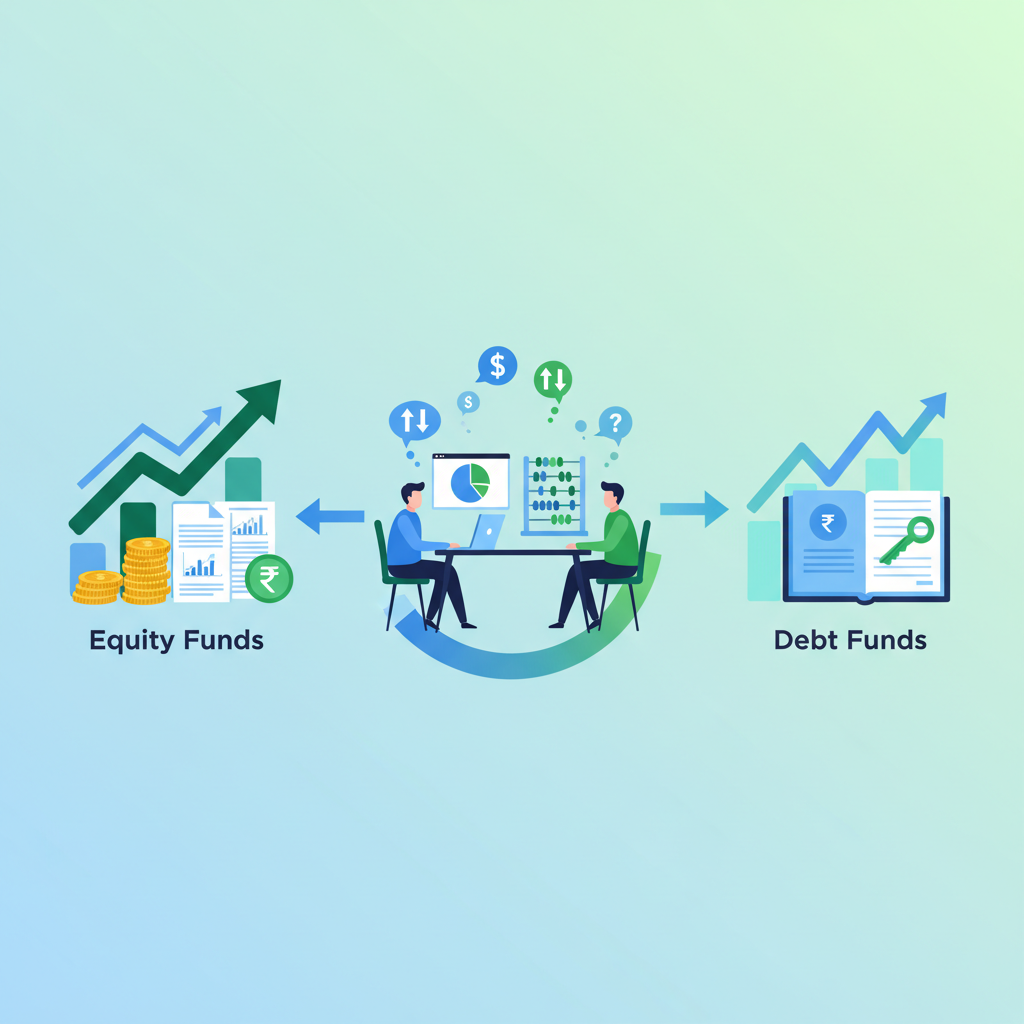
Ever stared at your mutual fund statement, a mix of excitement and confusion? You see 'equity' funds promising big gains, 'debt' funds sounding safe and steady, but... what’s the real deal? How do you actually compare them to get the *best* mutual fund returns for *your* money?
It’s a question I hear all the time. Just last week, Priya, a young professional in Pune earning around ₹65,000 a month, asked me, “Deepak, my friend Rahul in Hyderabad, he’s all about equity. Says it’s the only way to get rich. But my dad keeps telling me to be safe with debt funds. How do I actually figure out which one is right for *me*?” Priya’s not alone in this dilemma. Most salaried professionals in India face this exact puzzle – how to balance growth with safety. Understanding how to compare equity & debt funds isn't just theory; it's about making smart choices for your financial future.
Demystifying Equity Funds: Your Growth Engine (and the Bumpy Ride)
Alright, let's talk about equity funds first. Think of them as your primary engine for wealth creation. When you invest in an equity mutual fund, your money primarily goes into buying shares of various companies listed on stock exchanges like the NSE or BSE. So, when these companies perform well, their stock prices go up, and your fund's value increases. Simple, right?
But here’s the kicker: company performance isn't always linear. Markets can be volatile. Ever felt that rush when the Nifty 50 or SENSEX jumps, and then the pang of worry when it dips? That’s the nature of equity. High risk, yes, but also historically, high potential returns over the long term. This is where the magic of compounding really shines!
Within equity, you’ve got a whole spectrum: large-cap funds (invest in big, established companies, generally more stable), mid-cap funds (invest in medium-sized companies, higher growth potential but more volatile), small-cap funds (invest in small companies, highest risk-reward), multi-cap, flexi-cap funds (fund managers have flexibility across market caps), and even ELSS funds (equity-linked saving schemes) that give you tax benefits under Section 80C. Each has its own flavour of risk and return potential.
Who is this for? Someone like Rahul, for sure. He’s 30, earns ₹1.2 lakh/month in Hyderabad, and his goal is retirement in 25 years. He has a long time horizon, he’s comfortable with market ups and downs because he knows time will iron out the wrinkles. For him, a significant portion in equity funds makes perfect sense. Remember though, for any past returns you see advertised, always add this little note to yourself: Past performance is not indicative of future results.
Understanding Debt Funds: Your Stability Anchor (and the Gentle Current)
Now, let’s pivot to debt funds. If equity funds are your growth engine, debt funds are your stability anchor. Instead of company shares, these funds invest in fixed-income securities like government bonds, corporate bonds, debentures, and money market instruments. Basically, when you invest in a debt fund, you're lending money, and in return, you get interest payments.
The biggest appeal of debt funds is their relatively lower volatility compared to equity. They aim to provide stable, moderate returns and preserve your capital. Think of them as a cushion for your portfolio, especially during market downturns. They don't give you explosive growth, but they don’t give you sleepless nights either.
Just like equity, debt funds come in various types: liquid funds (for very short-term, instant access), ultra-short duration, short duration, corporate bond funds, Gilt funds, and banking & PSU funds. Each category has different risk profiles, mainly concerning interest rate risk (how changes in interest rates affect bond prices) and credit risk (the risk that the issuer might default).
Who benefits from debt funds? Someone like Anita in Chennai, who’s nearing retirement in 3-4 years. Her primary goal isn’t aggressive growth but preserving her existing capital and generating a steady income. Or perhaps you're saving for a down payment on a car in the next 2 years – a short-term goal where you cannot afford market volatility. Debt funds fit perfectly here. While generally safer, it's crucial to understand that even debt funds aren't completely risk-free. Again, Past performance is not indicative of future results.
Comparing Equity & Debt Funds: The Real Game Changer for Your Returns
Here’s where the magic truly happens: it's not about picking *either* equity *or* debt. It's about figuring out the *right mix* of both. This is where most people get stuck, trying to find a mythical 'best fund' instead of focusing on their own situation. The real game-changer when you compare equity & debt funds isn't just about their individual return potential, but how they work together.
Honestly, most advisors won’t tell you this bluntly, but your personal comfort with risk is paramount. How much sleep will you lose if your portfolio drops by 10-20% in a month? Be brutally honest with yourself. If you can’t stomach the dips, even if you intellectually understand equity's long-term potential, you'll likely panic and sell at the wrong time.
Then, consider your financial goals and time horizon:
- Short-term goals (1-3 years): Funds for a new gadget, a vacation, or an emergency fund. You need safety and easy access. Debt funds (like liquid or ultra-short duration) are your best bet.
- Medium-term goals (3-7 years): Saving for a car, a child’s initial schooling. A balanced approach with a higher allocation to debt and some equity could work.
- Long-term goals (7+ years): Retirement, child’s higher education, buying a house. Here, equity funds should form the core, given their potential for inflation-beating returns.
Take Vikram from Bengaluru, 40 years old, saving for his child’s higher education in 10 years. For him, a blend of equity (perhaps flexi-cap or large-cap for core growth) and some debt (like corporate bond funds for stability) would be a sensible strategy. It’s dynamic, not static. As the goal approaches, he'd systematically shift more of his investments from equity to debt to protect the accumulated capital.
Crafting Your Winning Portfolio: The Power of Blending
This brings us to the actual art of building a portfolio – what we call asset allocation. It's deciding how much of your money goes into equity and how much into debt. It’s the single most important decision you'll make, even more than picking specific funds.
For those who prefer a professional hand in balancing, there are Balanced Advantage Funds (BAFs), sometimes called Dynamic Asset Allocation funds. These funds use a pre-defined model to automatically shift between equity and debt based on market conditions, valuation, or other metrics. They aim to protect your downside during market corrections while still participating in the upside. It’s what I’ve seen work for many busy professionals who don't have the time or expertise to rebalance their portfolios manually.
Regardless of your allocation, discipline is key. Investing via Systematic Investment Plans (SIPs) is non-negotiable for most salaried folks. It averages out your purchase cost over time and builds wealth systematically. Want to see how even a small, regular amount can grow over time? Check out this SIP calculator to play around with different amounts and tenures.
And don’t forget to review your portfolio at least once a year. Life changes, goals shift, and so should your asset allocation. Rebalancing means bringing your equity-debt mix back to your desired levels. For instance, if equity has done exceptionally well and now makes up 80% of your portfolio instead of your target 60%, you might trim some equity and reallocate to debt.
Common Mistakes People Make When Comparing Equity & Debt Funds
Alright, let’s get real. After advising countless individuals, I've seen some recurring blunders. Here are the big ones:
- Chasing Past Returns: This is probably the biggest trap! People see a fund that gave 30% last year and jump in. But as we keep saying, past performance is not indicative of future results. A fund that did well yesterday might not tomorrow. Focus on consistency, fund manager's philosophy, and how it fits your goal, not just the latest numbers.
- Ignoring Risk Tolerance: Investing heavily in equity because a friend made money, only to panic and sell when the market corrects. Understand *your* risk appetite, not someone else's.
- Not Understanding Fund Categories: Treating all equity funds as one, or all debt funds as another. A small-cap equity fund behaves very differently from a large-cap. Similarly, a liquid fund is worlds apart from a long-duration corporate bond fund. Read the Scheme Information Document (SID) carefully – SEBI mandates this for a reason!
- Lack of Rebalancing: Your portfolio needs a check-up. If equity performs exceptionally well for a few years, it might become an outsized portion of your portfolio, increasing your overall risk. Without rebalancing (trimming high-performing assets, adding to underperforming ones), you drift away from your target asset allocation.
- Getting Swayed by 'Hot Tips': Everyone has an opinion on the next big thing. While AMFI’s “Mutual Funds Sahi Hai” campaign has done wonders for awareness, individual research, understanding, and aligning with *your* personal goals are far more important than any 'hot tip'.
Frequently Asked Questions on Comparing Equity & Debt Funds
We've covered a lot, but some questions always pop up. Here are answers to what people actually Google:
I hope this makes your mutual fund journey a little clearer. Remember, investing is a marathon, not a sprint. The goal isn't to get rich quick, but to build lasting wealth systematically and smartly.
Ready to start planning your financial goals and see how much you need to invest? Use a goal SIP calculator to map out your journey. It's a great first step.
Mutual Fund investments are subject to market risks, read all scheme related documents carefully.