How to Invest ₹5,000 Monthly to Build ₹1 Crore? | Step-Up SIP Calculator

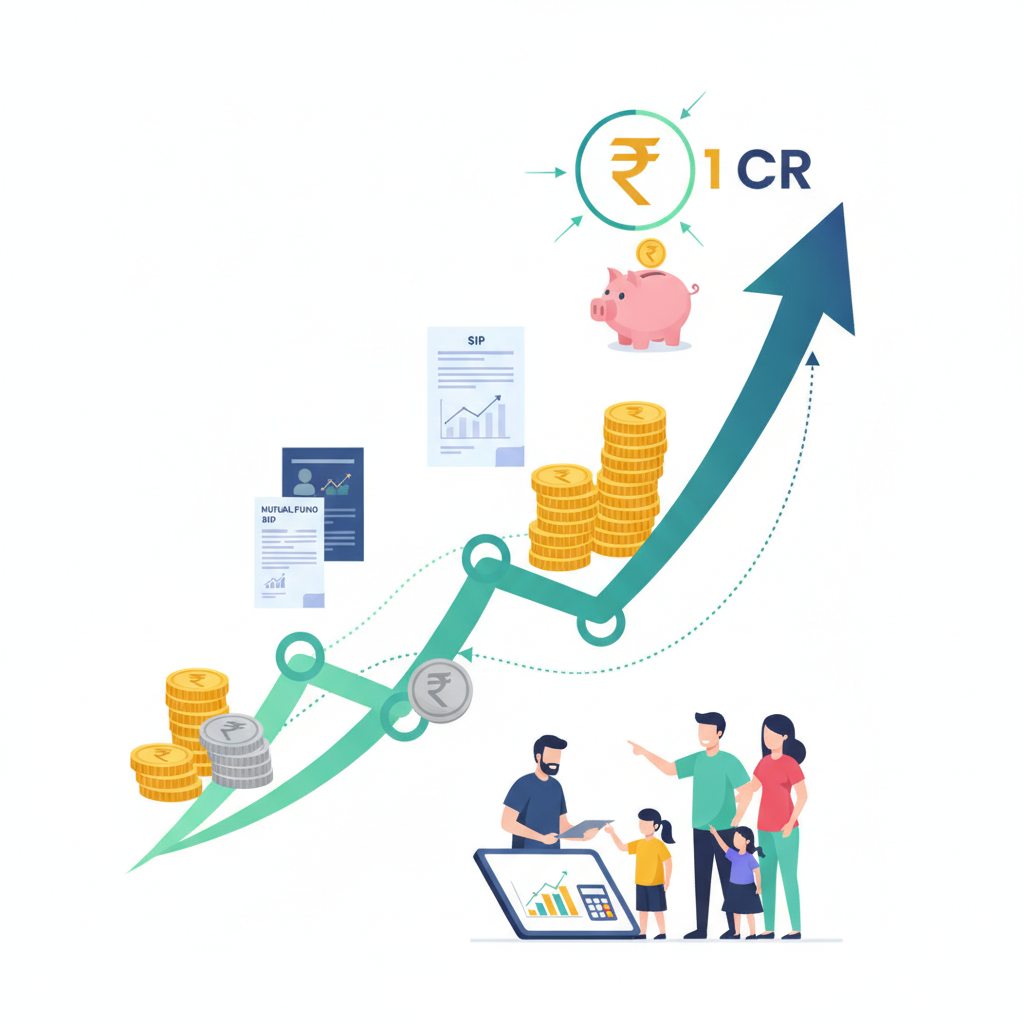
Arjun, a 26-year-old software test engineer in Bengaluru earning ₹45,000 a month, sat staring at his laptop screen at midnight, feeling a familiar pinch of anxiety as he realized his bank account held exactly ₹3,400 just five days before payday. He desperately wanted to know how to invest ₹5,000 monthly to build ₹1 Crore, but his initial calculations using a basic online tool left him deeply discouraged. Investing a flat ₹5,000 monthly at an estimated 12% annual return would take an agonizing 28 years to reach his goal. What Arjun did not realize—and what many corporate employees overlook—is that his income will not remain flat for three decades, and his monthly investment shouldn't either. By aligning his savings with his career growth, he could reach his destination years ahead of schedule.
Why Flat SIP Calculations Fail: How to Invest ₹5,000 Monthly to Build ₹1 Crore?
When you use a standard, static systematic investment plan (SIP) calculator, it assumes you are a frozen entity. It assumes that the ₹5,000 you invest today as a junior professional will be the exact same amount you invest 15 or 20 years later when you are a senior manager or department head. This is a fundamental flaw in traditional financial planning. Data from the Association of Mutual Funds in India (AMFI) regularly reports surging monthly SIP contributions—recently crossing the milestone of ₹20,000 crore per month—which indicates that millions of Indians are starting their investment journeys. Yet, a large portion of these investors keep their contributions static for years, missing out on the compounding superpower of progressive increases.
In my experience analyzing portfolios of young professionals, the mental barrier of starting small is the biggest hurdle. One thing I’ve noticed is that people overestimate what they can do in one year, but wildly underestimate what they can achieve over ten years with a simple 10% annual step-up. If you do not raise your contributions as your income rises, you are effectively allowing lifestyle inflation to swallow your investable surplus. When your salary increases by 8% or 10% annually, your saving capacity should ideally increase at a similar, if not higher, rate. Treating your monthly SIP as a dynamic commitment rather than a static bill is the secret to accelerating your path to financial freedom.
The Mathematics of a Step-Up SIP
To understand how we slash the timeline to reach our eight-figure goal, we must look at the mathematical difference between a flat investment and a step-up model. In a standard SIP, the compounding formula operates on a fixed periodic payment. The future value is calculated based on a constant payment size, a fixed interest rate, and the number of periods. However, a step-up SIP functions as a geometric progression of payments, where the investment amount increases by a fixed percentage every year.
Suppose you start with a base investment of ₹5,000 per month. We will assume an estimated annual CAGR of 12% for both scenarios. Past performance is not indicative of future results.
In a Flat SIP scenario, you invest a flat ₹5,000 every single month for 20 years. Over these 240 months, your total capital contribution is ₹12,00,000. At an estimated 12% average annual return, your final portfolio value is approximately ₹49,95,740. You are still ₹50 Lakhs short of your dream. To hit ₹1 Crore under this flat model, you would have to wait nearly 28 years.
In a 10% Step-Up SIP scenario, you start with ₹5,000 per month, but at the end of every 12 months, you increase your monthly contribution by exactly 10%. In year two, you invest ₹5,500 monthly. In year three, you invest ₹6,050 monthly. By year ten, your monthly contribution grows to ₹11,790, and by year twenty, it stands at ₹30,580. Because your career has progressed over two decades, this ₹30,580 monthly commitment is likely to feel as comfortable as the ₹5,000 did when you were 26.
Under this step-up model, your total capital contribution over 20 years increases to ₹34,36,500. Thanks to the power of compounding on progressively larger sums, your estimated final corpus climbs to a stunning ₹1,03,44,700—over ₹1.03 Crore. By stepping up your SIP by just 10% each year, you shave 8 full years off your timeline and build a corpus that is double the size of the flat SIP.
Let us break down how the capital accumulates at different milestones of your 20-year journey under this 10% annual step-up:
- At Year 5: Your monthly investment has risen from ₹5,000 to ₹7,320. You have invested a total of ₹3.66 Lakhs. Your portfolio value sits at roughly ₹5.1 Lakhs. It feels slow, and you might start questioning the strategy.
- At Year 10: Your monthly investment is now ₹10,717. Your total invested capital is ₹10.3 Lakhs, and your portfolio is worth approximately ₹19.4 Lakhs. The compounding flywheel is starting to spin.
- At Year 15: You are investing ₹17,261 per month. Your total investment is ₹20.5 Lakhs, but your portfolio has surged to ₹47.8 Lakhs. The gains are now starting to outpace your contributions.
- At Year 20: Your final year's monthly contribution is ₹27,798. Your total lifetime contribution is ₹34.3 Lakhs, and your estimated corpus crosses the finish line at ₹1.03 Crore.
This step-by-step progression demonstrates that the bulk of your wealth is created in the final five years of the cycle. In the beginning, your own contributions do most of the heavy lifting. By the end, the accumulated growth of the previous years does the massive work. This is the beauty of long-term compounding.
Constructing Your Portfolio for the ₹1 Crore Journey
You cannot achieve an estimated 12% CAGR by keeping your money in safe, low-yield instruments like fixed deposits or traditional insurance policies. To target these compounding rates, you must venture into equity mutual funds, carefully categorized under SEBI’s guidelines to match your risk profile and investment horizon.
First, consider allocating a significant portion of your capital to Flexi-Cap Funds. Under SEBI rules, flexi-cap schemes must invest at least 65% of their assets in equities, but they have the complete freedom to navigate across large-cap, mid-cap, and small-cap stocks without any restrictive limits. This flexibility is crucial over a 20-year horizon. When large-caps are overvalued, the fund manager can tilt the portfolio toward mid-caps to capture growth; when the market faces a downturn, they can retreat to the safety of giant, stable corporations.
Second, an Index Fund tracking the Nifty 50 or Nifty LargeMidcap 250 is an excellent foundation. The Nifty 50 index has historically delivered a CAGR in the range of 11% to 13% over long rolling periods. Past performance is not indicative of future results. Index funds carry lower expense ratios because they are passively managed, meaning less of your hard-earned money is eaten up by management fees over twenty years.
Third, for individuals looking for tax optimization alongside wealth creation under the older tax regime, Equity Linked Savings Schemes (ELSS) can play a dual role. ELSS funds come with a mandatory three-year lock-in period, which is actually a psychological blessing in disguise. It prevents you from panic-selling during market corrections, allowing your money to compound undisturbed.
When building this portfolio, the choice between active mutual funds and passive index funds is critical. Active funds rely on a fund manager's skill to select stocks that will beat the benchmark. While top-performing active flexi-cap funds can deliver returns that outperform the Nifty 50, they also come with a higher expense ratio—often ranging between 0.75% to 1.5% for direct plans, and up to 2.5% for regular plans. Over a 20-year horizon, an extra 1% in fees can cost you lakhs of rupees. Always choose direct plans over regular plans when setting up your systematic investment plan. By bypassing distributor commissions, you keep that extra 1% to 1.5% compounding in your own account year after year.
A balanced portfolio for a long-term goal like this might look like this:
- Flexi-Cap Funds (50% allocation): For dynamic, active market exposure across all company sizes.
- Index Funds (30% allocation): For low-cost, steady exposure to India's top corporate giants.
- Mid-Cap or Large & Mid-Cap Funds (20% allocation): For an extra growth kicker, capturing the rapid expansion of India's mid-sized enterprises.
The Realities of Inflation, Tax Drag, and Sequence of Returns
While aiming for a massive numeric target is exciting, we must look at the structural factors that will impact your real-world wealth. The most significant hidden force is inflation. The Reserve Bank of India (RBI) historically aims to keep retail inflation within a target comfort zone of 4% to 6%. If we assume a long-term average inflation rate of 6%, a ₹1 Crore corpus in 20 years will possess the purchasing power of approximately ₹31 Lakhs today. This means that while you will technically be a crorepati, your lifestyle costs will also have risen. To combat this, you should try to step up your SIP by a percentage that matches or exceeds your personal lifestyle inflation.
Another critical factor is the tax drag. Under current Indian tax laws, Long-Term Capital Gains (LTCG) on equity mutual funds are taxed at 12.5% on gains that exceed ₹1.25 Lakhs in a single financial year, provided the holding period is over 12 months. This means that when you eventually redeem your ₹1 Crore corpus, a portion of your profits will go toward taxes. While you cannot avoid taxes, you can plan your redemptions systematically over multiple financial years to utilize the annual tax-free threshold efficiently.
Finally, you must brace yourself for the sequence of returns risk. Your portfolio will not grow in a smooth, upward linear trajectory of 12% every year. You might experience periods like 2008 or 2020 where the market drops by 30% or more in a matter of months, followed by years of explosive growth. If a severe market crash occurs in year 18 of your 20-year journey, it can temporarily dent your accumulated corpus. Managing this risk involves gradually shifting a portion of your profits from high-risk equity funds into stable liquid or debt funds as you get within 2 to 3 years of your target deadline.
If you experience poor market returns in the first five years of your SIP, it is actually a blessing in disguise. It allows you to accumulate a massive number of mutual fund units at lower prices. When the market eventually bull-runs in the later years, those cheap units will skyrocket in value. However, if the market crashes in your 19th or 20th year, the impact can be devastating because your portfolio size is at its peak. Implementing an asset allocation transition plan via a Systematic Transfer Plan (STP) as you approach your deadline ensures that your ₹1 Crore goal is secured and locked in, regardless of sudden market crashes right before your target date.
Avoid These Crucial Pitfalls on Your Wealth Journey
The greatest enemy of a long-term systematic investment plan is not market volatility; it is human behavior. Over my years researching personal finance trends, I have seen countless well-intentioned plans fall apart due to avoidable mistakes.
First, many investors make the error of stopping their monthly SIP when the market goes through a correction. When news headlines scream about economic downturns, the natural instinct is to preserve cash. However, this completely defeats the purpose of rupee cost averaging. When prices fall, your fixed monthly contribution buys more mutual fund units. When the market eventually recovers, these cheap units act as a high-powered engine for your portfolio. Pausing your SIP during a crash is like refusing to buy your favorite clothes when they are on a 40% discount.
Second, relying on manual intervention to step up your investments is a recipe for failure. If you tell yourself that you will manually increase your SIP by ₹500 every time you get a raise, you will likely find other uses for that money. A new smartphone, an exotic vacation, or a premium lifestyle upgrade will always seem more urgent than a goal twenty years away. The easiest solution is to select the "Auto Step-Up" option when setting up your mutual fund mandate, allowing the system to scale your contributions automatically.
Third, do not over-complicate your portfolio by investing in too many schemes. I have met young professionals investing ₹5,000 monthly split across eight different mutual funds, putting ₹500 or ₹600 into each. This does not provide extra diversification; it simply causes extreme portfolio overlap where multiple funds hold the exact same stocks. It also makes tracking performance, filing taxes, and managing accounts a bureaucratic nightmare. Two or three carefully chosen, distinct funds are all you need to build long-term wealth.
Fourth, treating equity investments like liquid savings is a silent compounding killer. Many salaried professionals redeem a portion of their mutual funds to pay for short-term desires like a holiday or a gadget upgrade. Every time you redeem your funds, you reset the compounding clock back to zero. Equity SIPs should be treated as untouchable capital reserved strictly for your long-term milestones.
Using a Step-Up Calculator: How to Invest ₹5,000 Monthly to Build ₹1 Crore
Building a significant corpus requires personalizing the variables to fit your unique financial situation. If a 10% annual increase feels too steep right now, you might want to see what happens if you start with a 5% step-up, or perhaps start with a slightly higher base amount of ₹7,000. To run these customized scenarios and find your own perfect path, you can use our interactive sip step-up calculator to play with different parameters, growth rates, and investment tenures. Taking five minutes today to model your trajectory can give you the clarity and confidence needed to stay committed for the long haul.
Mutual Fund investments are subject to market risks. This article is for educational and informational purposes only and does not constitute financial advice. Please read all scheme-related documents carefully and consult a SEBI-registered investment advisor before investing.