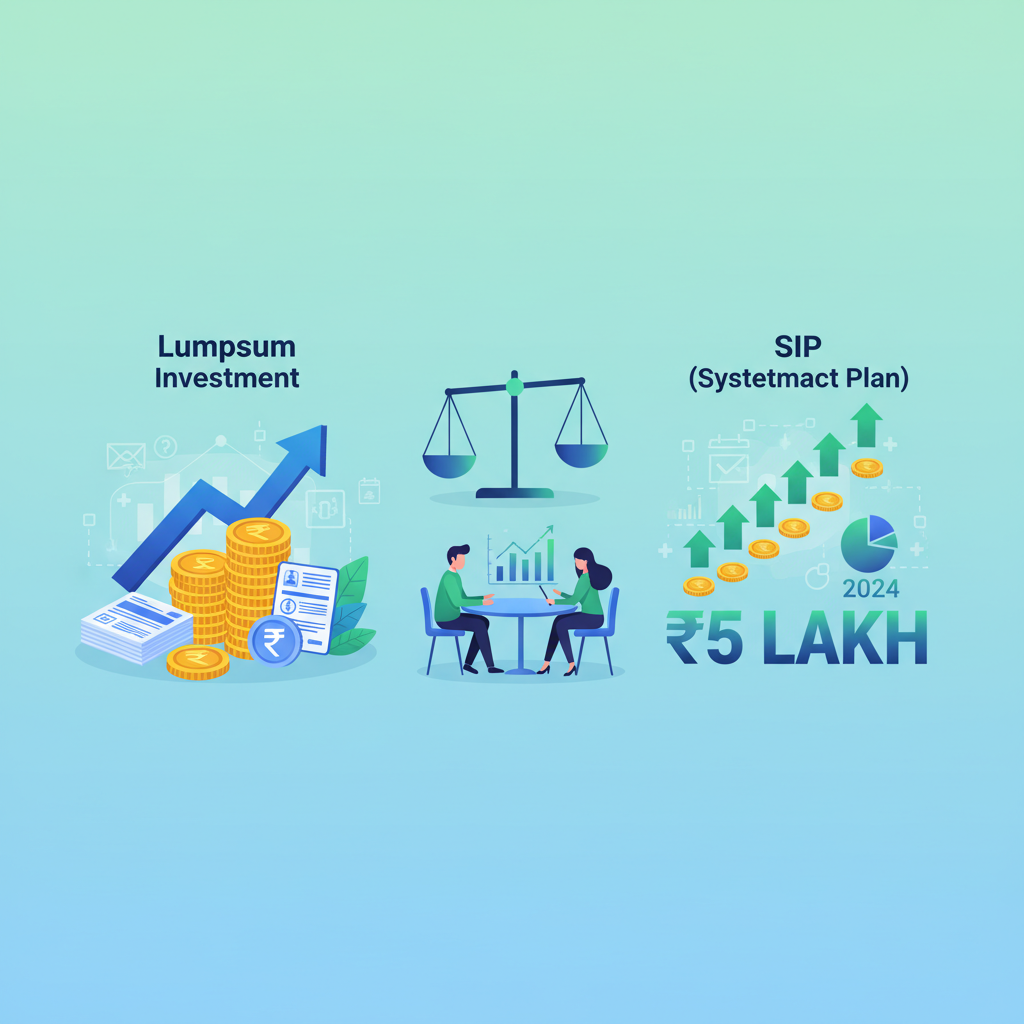
Lumpsum Investment vs. SIP: Which is Better for ₹5 Lakh in 2024?
 View as Visual Story
Hey there! Deepak here, your friendly finance guy who’s been navigating the Indian mutual fund landscape for over eight years now. I've seen countless folks like you – smart, salaried professionals – scratching their heads when a nice chunk of money, say, ₹5 lakh, lands in their lap. Maybe it’s a Diwali bonus that really hit the mark, a hefty appraisal hike, a gift, or even that ancestral property sale. The big question always pops up: Lumpsum Investment vs. SIP: Which is Better for ₹5 Lakh in 2024?
I recently chatted with Priya, a software engineer in Bengaluru, who just got a ₹5 lakh performance bonus. Her salary's good (around ₹1.2 lakh/month), but this extra cash felt like a golden ticket. She was torn. "Deepak," she asked, eyes wide with possibility (and a little fear), "Should I just dump it all in at once, or break it up into monthly bits? My uncle in Chennai swears by SIP, but my colleague in Hyderabad just put his whole bonus into one go and says he's already made a profit!"
Priya's dilemma is super common, and honestly, the answer isn't a simple 'A' or 'B'. It depends on a few things: your comfort with risk, your understanding of how markets actually move, and sometimes, just plain old human psychology. Let's dig in.
The Basics: What's the Difference Between SIP vs Lumpsum?
Alright, let's quickly iron out what these terms even mean, just in case you're new to the game or need a refresher.
- Lumpsum Investment: This is when you invest a large sum of money, like Priya's ₹5 lakh, all at once into a mutual fund scheme. Think of it like buying a whole basket of groceries in one go for the entire month. You pay for everything upfront.
- SIP (Systematic Investment Plan): This is where you invest a fixed amount at regular intervals – typically monthly – into a mutual fund. So, instead of ₹5 lakh at once, you might invest ₹40,000 every month for 12.5 months. It's like paying for your groceries week by week, or in our example, month by month.
Both methods aim to grow your wealth through mutual funds. But their approaches to tackling market volatility are vastly different.
The 'Market Timing' Myth: Why a Single ₹5 Lakh Lumpsum Can Be a Rollercoaster
Picture Rahul, a marketing manager in Pune. He inherited ₹5 lakh and, feeling bullish about the market, decided to put it all into a Nifty 50 index fund in January 2024. Great! The market was doing well then. But what if he had invested in, say, February 2020, just before the COVID-induced crash? He would have seen a significant dip very quickly, and his ₹5 lakh would have temporarily shrunk considerably.
This is the biggest challenge with lumpsum investing: market timing. We all wish we could buy low and sell high, right? But the truth is, consistently timing the market is incredibly difficult, even for seasoned professionals. Unless you have a crystal ball (and if you do, please share!), trying to pinpoint the absolute 'best' day to invest your entire ₹5 lakh is a fool's errand.
Here's what I've seen work for busy professionals: most folks get swept up in the market euphoria when things are booming, and that's often when they decide to put in a lumpsum. The risk? You might be investing at a peak, meaning your investment could face a correction shortly after, leaving you feeling frustrated and worried. Historically, the Indian markets (think Sensex or Nifty 50) have seen their share of ups and downs. A lumpsum investment fully exposes you to that single point in time's market conditions.
The Power of Averaging: Why SIP is the Salaried Professional's Best Friend
This is where SIPs truly shine. Imagine Anita, an HR executive in Delhi, who decided to invest her ₹5 lakh bonus not as a lumpsum, but by setting up an STP (Systematic Transfer Plan). An STP is essentially a way to deploy a lumpsum into the market over time by first putting it in a liquid fund, and then systematically transferring a fixed amount into an equity fund via monthly SIPs. Say she puts her ₹5 lakh into a liquid fund and sets up a monthly transfer of ₹40,000 into a flexi-cap fund.
This strategy leverages what's called Rupee-Cost Averaging. When the market is high, your fixed SIP amount buys fewer units. When the market is low, the same fixed amount buys more units. Over time, this averages out your purchase cost, reducing the impact of market volatility. It smooths out the bumps in the road.
For most salaried professionals, especially those managing a monthly budget, a SIP feels natural. It instills discipline and removes the emotional component of trying to time the market. You're consistently investing, come rain or shine, making you a participant in the market's long-term growth story. In fact, AMFI data consistently shows the growing adoption of SIPs, indicating a maturity in how Indian investors approach wealth creation.
Want to see how your regular SIPs could potentially grow? Check out this handy SIP calculator. It's a great tool to estimate future value based on different rates and durations.
When Lumpsum *Might* Make Sense (and the Catch!)
"So, Deepak, never a lumpsum then?" you might ask. Not necessarily! There are specific scenarios where a lumpsum investment could be beneficial, but it comes with a big 'if'.
1. Significant Market Correction: If the market has undergone a sharp, sustained correction (think 15-20% or more), and you have strong conviction that the worst is behind us, a lumpsum investment at that point could offer higher potential returns. But again, this requires a deep understanding of market cycles and a strong stomach for risk. It's like finding a high-quality product on sale – a great opportunity if you know its true worth.
2. Very Long Investment Horizon: If you're investing for 15-20+ years, the initial entry point's impact tends to diminish over such a long duration. The power of compounding eventually smooths out short-term fluctuations.
3. Seasoned Investors with Market Knowledge: If you're someone who actively tracks market trends, understands valuations, and has the discipline to make unemotional decisions, a well-timed lumpsum could theoretically outperform a SIP. But this is a rare breed, not your average salaried professional focused on their career.
The Catch? These scenarios require a level of market expertise and emotional control that most of us simply don't have. Most of us, myself included, are better off sticking to a disciplined, systematic approach.
So, What About Your ₹5 Lakh in 2024? A Practical Approach from Deepak
Honestly, most advisors won't tell you this, but here's what I’ve seen work for busy professionals: for a ₹5 lakh amount, especially if it's unexpected money, a blended approach often makes the most sense. It gives you the best of both worlds and mitigates risk.
Here’s my take:
- Don't sit on it! The worst thing you can do is keep the ₹5 lakh in your savings account earning peanuts while you overthink. Inflation is silently eating away at its value.
- Consider an STP (Systematic Transfer Plan): This is my favourite recommendation for a lumpsum like ₹5 lakh. Park your entire ₹5 lakh in a safe, low-risk liquid fund (or an ultra-short duration fund) within the same mutual fund house. Then, set up an STP to systematically transfer, say, ₹40,000-₹50,000 every month over the next 10-12 months into an equity fund of your choice (e.g., a good flexi-cap fund, an ELSS for tax saving if applicable, or a balanced advantage fund for some stability). This way, your money isn't just sitting idle, and you're still leveraging rupee-cost averaging.
- If you're genuinely comfortable with risk and the market has seen a dip: If you've been tracking the market and feel it's genuinely undervalued after a significant correction, you could invest a portion (say, 20-30%) as a lumpsum and STP the rest. But this requires courage and conviction.
- Align with your goals: Is this ₹5 lakh for a short-term goal (less than 3 years) or a long-term one? For short-term goals, equity mutual funds (SIP or lumpsum) are generally too risky. For long-term goals (5+ years), equity exposure is crucial for wealth creation.
Remember what SEBI always says: mutual fund investments are subject to market risks. There are no guarantees, but understanding the tools at your disposal helps immensely.
Common Mistakes People Make with Lumpsum or SIP
Even with the best intentions, investors often trip up. Here are a few common pitfalls:
- Stopping SIPs During Market Falls: This is perhaps the biggest mistake. When markets drop, your SIP buys more units at a lower price. Stopping it means you miss out on the crucial compounding and averaging benefits precisely when they matter most.
- Chasing Past Returns: Don't blindly invest a lumpsum or start a SIP in a fund just because it gave phenomenal returns last year. Past performance is not indicative of future results. Focus on consistency, fund manager experience, and the fund's investment philosophy.
- Not Having a Goal: Investing ₹5 lakh without a clear goal (retirement, child's education, home down payment) is like driving without a destination. Your goal dictates your risk tolerance and investment horizon.
- Putting All Eggs in One Basket: Whether it's a lumpsum or a SIP, diversify! Don't put all ₹5 lakh into a single sector fund or a single mid-cap fund. Spread it across different categories based on your risk profile.
Frequently Asked Questions About Investing ₹5 Lakh
Here are some questions I often get from folks trying to decide on the best way to invest ₹5 lakh:
1. Can I convert a lumpsum investment into a SIP?
Absolutely! This is exactly what an STP (Systematic Transfer Plan) helps you do. You invest your ₹5 lakh as a lumpsum into a low-risk fund (like a liquid fund) and then set up automatic, regular transfers (like a SIP) from that fund into your chosen equity mutual fund. This is a fantastic way to mitigate market timing risk for a larger sum.
2. Is SIP always better than lumpsum for ₹5 lakh?
Not always, but generally, for most retail investors, SIP is the more practical, disciplined, and less stressful approach, especially for an amount like ₹5 lakh. A lumpsum can potentially generate higher returns if invested at a market low, but predicting market lows is extremely difficult. For long-term wealth building, SIP's rupee-cost averaging benefits are hard to beat.
3. What if I have ₹5 lakh now, should I wait for a market fall?
Deepak's advice: don't try to time the market. You might wait for months, even years, and miss out on potential gains, or the market might just keep going up. A better strategy for your ₹5 lakh would be to deploy it gradually through an STP, or if your risk appetite is high and you believe the market is currently undervalued, invest a portion as lumpsum and STP the rest. Sitting on the sidelines can be costly due to inflation.
4. Which mutual funds are good for SIP/Lumpsum for ₹5 lakh?
The best fund depends entirely on your financial goals, risk tolerance, and investment horizon. For long-term wealth creation, funds like flexi-cap funds (which invest across market caps), multi-cap funds, or even large-cap funds are popular choices. If tax saving is a goal, an ELSS fund might be suitable (with a 3-year lock-in). For a slightly more conservative approach, a balanced advantage fund could be considered for an STP strategy. Always do your research or consult a SEBI-registered advisor before investing.
5. How much can I expect from ₹5 lakh invested via SIP or lumpsum?
It's impossible to promise specific returns, as mutual fund returns are market-linked and not guaranteed. Historical data suggests equity mutual funds have the potential to generate returns in the range of 10-15% annually over the long term, but past performance is not indicative of future results. Your actual returns will depend on market conditions, the specific funds you choose, and your investment horizon. The longer you stay invested, the greater the potential for compounding to work its magic.
Wrapping It Up: Your ₹5 Lakh Journey
So, there you have it. Whether you go with a lumpsum or an SIP for your ₹5 lakh largely boils down to your comfort level, market understanding, and emotional discipline. For most salaried professionals, my honest recommendation is to lean towards a systematic approach – either a direct SIP if you're building up savings, or an STP if you have a lump sum in hand. It's less stressful, more disciplined, and leverages the power of rupee-cost averaging.
Don't let that ₹5 lakh just sit there. Make a plan, stick to it, and watch your wealth grow over time. Remember, the journey of a thousand financial miles begins with a single, well-thought-out investment step.
Ready to plan your systematic investments? Give the Goal SIP Calculator a spin to see how regular investments can help you reach your dreams!
Disclaimer: This blog post is for educational and informational purposes only and should not be considered as financial advice or a recommendation to buy or sell any specific mutual fund scheme. Mutual Fund investments are subject to market risks, read all scheme related documents carefully. Past performance is not indicative of future results.