Lumpsum vs SIP: Best for House Down Payment in 5 Years?

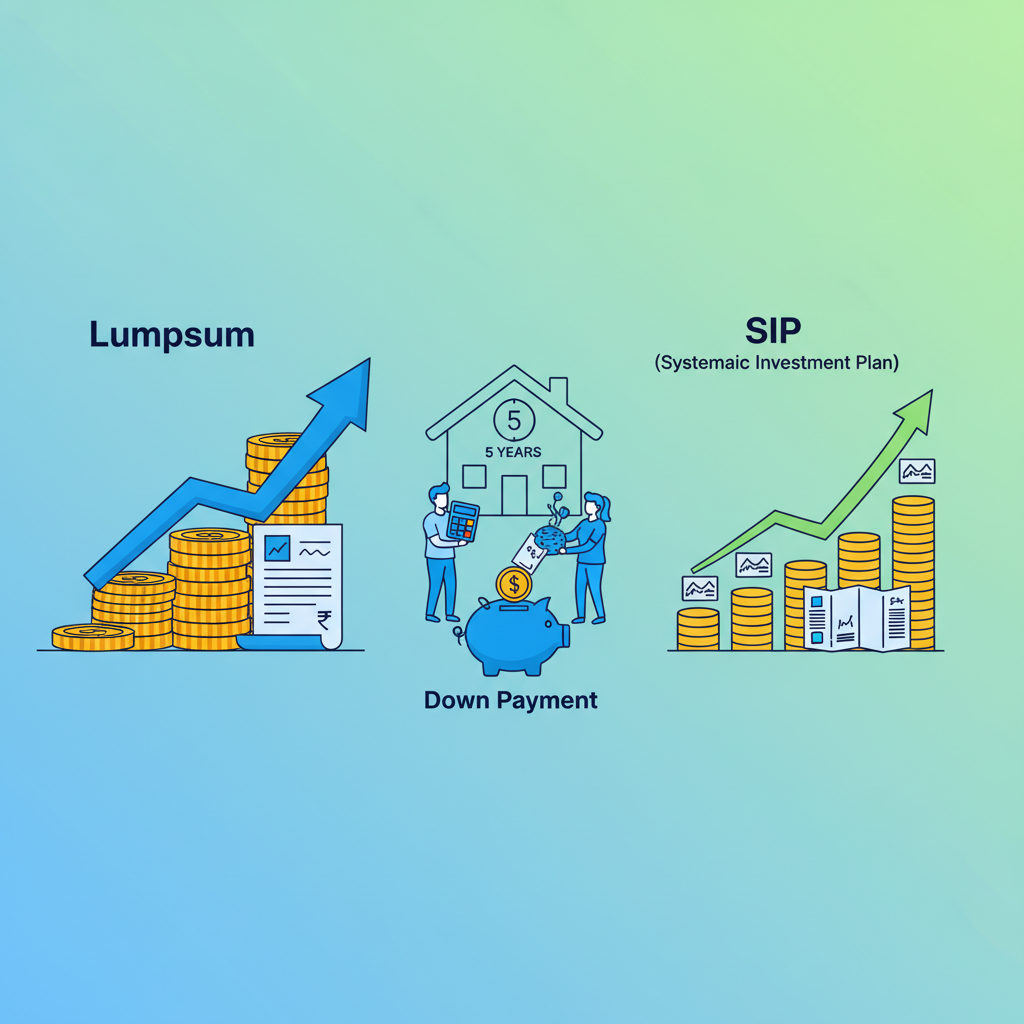
Alright, so picture this: You’re scrolling through Instagram, admiring those gorgeous, sun-drenched apartments in Bengaluru or the cozy bungalows in Pune. Suddenly, you get that familiar pang – the dream of owning your own home. But then reality hits. The down payment!
It’s a massive hurdle for most salaried professionals in India. And the first question that pops up, especially if you have a lump sum sitting somewhere (maybe an annual bonus, an inheritance, or even a PF withdrawal from an old job), is always: Lumpsum vs SIP – which is best for that house down payment in, say, 5 years?
I’m Deepak, and after 8+ years of chatting with folks like you – IT professionals in Hyderabad, marketing managers in Chennai, entrepreneurs in Delhi – about their financial goals, I’ve seen this dilemma play out countless times. Let’s cut through the jargon and figure out what makes sense for your hard-earned money.
Decoding the Basics: Lumpsum vs SIP for Your Dream Home
Before we dive deep, let’s quickly define our players. A lumpsum investment is when you put a significant amount of money into a mutual fund all at once. Think of it like a big splash. An SIP (Systematic Investment Plan), on the other hand, is like a steady drizzle – you invest a fixed amount regularly (monthly, quarterly) into the same fund. Most of you are probably already doing SIPs for your long-term goals.
Now, why is that 5-year timeline so crucial? Honestly, most advisors won't tell you this, but 5 years falls into that tricky medium-term category. It's not long enough to ride out multiple market cycles with absolute confidence if you're purely in equities, but it's also not short enough to just stick everything in a bank FD and beat inflation. This timeframe demands a balanced approach, and that's where the lumpsum vs SIP debate truly heats up.
Let's consider Priya from Pune. She got a ₹5 lakh bonus last year. Her immediate thought was, "Great! I'll put this into a good mutual fund for my down payment in 4 years." She invested it as a lump sum. Now, if the market had a fantastic run, she'd be smiling. But what if it dipped? That's the core risk.
The Lumpsum Advantage (and Its Big Catch for Down Payments)
There's an undeniable allure to lumpsum investing. Imagine you have ₹10 lakh from selling a plot of land or a large performance bonus. The thought of putting it all in one go and watching it grow feels powerful, right?
Historically, if you had invested a lump sum in the Nifty 50 during a significant market correction and held it for many years (think 10+), the returns could be spectacular. This is because you bought low. And sometimes, you just get lucky. Say, Rahul from Hyderabad received ₹15 lakh from an ancestral property sale and invested it just before a major bull run. His corpus would likely see significant growth in a relatively short period.
However, here's the *big catch* for a 5-year down payment goal: **market timing is incredibly difficult, almost impossible, to get right consistently.** If you invest a lump sum today, and the market decides to take a significant dip tomorrow (which, let's be honest, can happen), your entire corpus takes a hit. With only 5 years on the clock, you might not have enough time for that investment to recover and deliver the kind of returns you're hoping for. Remember, past performance is not indicative of future results, and predicting short-term market movements is a fool's errand.
For a goal like a house down payment, where you *need* that money by a certain date, betting your entire savings on a one-time market entry can be a high-stakes gamble. It adds unnecessary stress to an already stressful goal.
Why SIP Often Wins for Your Down Payment Goal (Especially in India)
This is where SIPs shine, especially for salaried professionals in India. Here’s what I’ve seen work for busy professionals like Anita, a software engineer in Bengaluru earning ₹1.2 lakh a month, or Vikram, a government employee in Chennai making ₹65,000.
-
Rupee-Cost Averaging (RCA): This is the superpower of SIPs. When markets are high, your fixed SIP amount buys fewer units. When markets are low, the same amount buys more units. Over time, this averages out your purchase price, reducing the impact of market volatility. It takes the guesswork out of timing the market. For a 5-year goal, this smoothing effect is invaluable.
-
Discipline and Automation: Let's be real, life gets in the way. With a SIP, your investment happens automatically, month after month. No need to remember, no temptation to hold back when markets look shaky. This consistent discipline is the secret sauce to wealth creation for most of us. Set it and forget it (well, mostly – a periodic review is good!).
-
Lower Risk Perception: While mutual funds are inherently subject to market risks, investing via SIP for a medium-term goal often *feels* less risky because your money isn't all exposed to a single market point. This psychological comfort is crucial when you're saving for something as big as a home.
-
Flexibility to Increase: As your salary grows (and we hope it does!), you can easily increase your SIP amount using a SIP Step-Up Calculator. This accelerates your savings, getting you to your down payment goal faster. Imagine Anita, who got a promotion and increased her SIP by 10% annually. Her down payment corpus will grow significantly quicker than if she just maintained a static SIP.
For a 5-year horizon, I typically suggest considering fund categories like Balanced Advantage Funds or even certain Flexi-Cap Funds. Balanced Advantage Funds dynamically manage asset allocation between equity and debt, trying to reduce downside risk while participating in market upside. This dynamic approach can be quite suitable for medium-term goals. Of course, always consider your personal risk tolerance and consult a SEBI-registered financial advisor.
What Most People Get Wrong When Saving for a Down Payment
After years of advising, here are a few common pitfalls I've seen:
-
Procrastination, Waiting for a 'Big Amount': Many feel they need a huge chunk of money to *start* investing for a down payment. So, they wait for that bonus, or a specific event. The biggest mistake is not starting. Even a small SIP of ₹5,000 or ₹10,000 today can make a massive difference over 5 years compared to waiting for a ₹1 lakh lump sum next year. Time in the market almost always beats timing the market.
-
Too Conservative (FDs) OR Too Aggressive (Small-Cap Funds): For a 5-year goal, FDs won't cut it. Property prices typically rise faster than FD returns, eroding your purchasing power. On the flip side, going all-in on small-cap or sectoral funds for a crucial 5-year goal is too risky. Small-cap funds can be highly volatile, and a dip right before your deadline could be catastrophic for your down payment. A diversified approach, leaning towards balanced advantage or flexi-cap funds, is usually the sweet spot.
-
Underestimating Inflation & Property Price Hikes: That ₹20 lakh down payment you envision today? In 5 years, it might be ₹25-28 lakh due to property appreciation and general inflation. You need your investments to grow at a rate that beats these increases. This is why FDs are insufficient.
-
Not Having a Clear Target: How much do you need for the down payment? When exactly? Using a Goal SIP Calculator helps you work backward. If you need ₹25 lakh in 5 years, and expect a potential 10-12% annual return from a balanced fund, the calculator will tell you how much you need to SIP monthly. This clarity is empowering.
FAQ: Your Down Payment & Mutual Fund Questions Answered
Q1: Can I really save enough for a down payment in 5 years with SIP?
Absolutely, it's possible! It depends on your current savings capacity, the down payment amount you need, and the potential returns from your chosen mutual fund. Start by figuring out your target down payment. Then, use a Goal SIP calculator to see how much you need to invest monthly to reach that goal in 5 years, assuming a realistic return expectation (e.g., 10-12% for balanced funds). If the monthly amount is high, consider increasing your current savings rate or extending your timeline slightly.
Q2: What if the market crashes right before my 5 years are up?
This is a valid concern for medium-term goals. To mitigate this, consider gradually de-risking your portfolio as you get closer to your goal. For instance, in the last 1-2 years, you could start moving your equity-oriented fund investments into safer avenues like debt funds or even FDs. This strategy helps protect your accumulated corpus from sudden market downturns just before you need the money. This is a common strategy employed by seasoned investors.
Q3: Which mutual fund category is best for a 5-year down payment goal?
For a 5-year horizon, I generally suggest categories that balance growth potential with relative stability. Balanced Advantage Funds (or Dynamic Asset Allocation Funds) are often a good fit as they automatically adjust their equity-debt allocation based on market conditions. Flexi-Cap Funds, which can invest across market caps without restriction, also offer good diversification. Avoid highly volatile funds like small-cap or sectoral funds for such a crucial goal. Always align with your risk profile.
Q4: Should I stop my SIP if the market falls?
No, definitely not! Stopping your SIP during a market fall is one of the biggest mistakes you can make. When markets fall, your SIP actually buys more units at a lower price, which is beneficial for your long-term returns through rupee-cost averaging. This is precisely when you should continue, or even consider increasing, your SIP. Panic selling or stopping SIPs during corrections can significantly hamper your wealth creation journey.
Q5: What's a good return expectation for 5 years from mutual funds?
While I can't guarantee any returns (no one can!), historically, well-managed diversified equity-oriented mutual funds have aimed for and sometimes delivered 10-14% CAGR over a 5-year period. However, remember that past performance is not indicative of future results, and returns can vary significantly based on market cycles, fund performance, and the fund category. It's prudent to use a slightly conservative estimate (e.g., 10-12%) in your calculations for a down payment goal.
So, there you have it. For most salaried professionals aiming for a house down payment in 5 years, a disciplined, consistent SIP approach generally trumps a one-off lumpsum. It's about building that dream brick by brick, month by month, with less stress and more predictability.
Don't just dream about that down payment, start planning for it today! Use a simple SIP Calculator to chart your path and see how achievable your homeownership dream truly is. The sooner you start, the better.
Mutual Fund investments are subject to market risks, read all scheme related documents carefully. This is for educational and informational purposes only and is not financial advice or a recommendation to buy or sell any specific mutual fund scheme.