Mutual Fund Returns: 10% vs 15% CAGR for long-term goals?

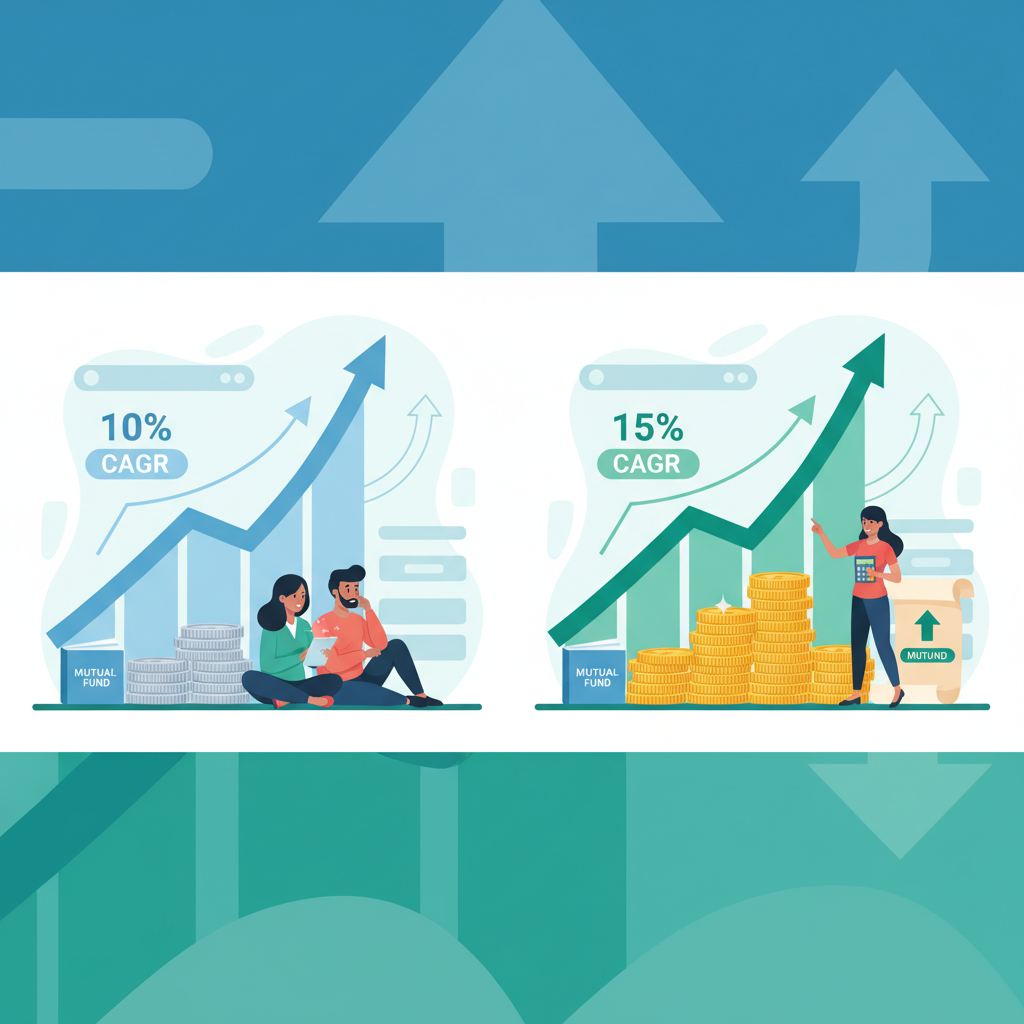
Alright, let's talk about something that probably keeps many of you, my fellow salaried professionals, up at night: those elusive mutual fund returns. Specifically, that big question mark hanging over your head: 10% vs 15% CAGR for long-term goals?
I get it. You're slogging through your job in Bengaluru or managing your family finances in Chennai, perhaps earning ₹1.2 lakh a month, and you've got dreams. A child's education, a comfortable retirement, maybe that swanky apartment down the line. And somewhere along the way, you heard that mutual funds could get you there, potentially delivering double-digit returns. But what's realistic? And what difference does a few percentage points actually make over the long run? Buckle up, because we’re going to dissect this like a pro, but in a language you and I understand.
The ₹50 Lakh Question: What's the Real Difference Between 10% and 15% Mutual Fund Returns?
Let's kick things off with a simple, yet powerful example. Meet Rahul. Rahul is a software engineer in Pune, earning a decent ₹80,000 a month. He’s 30, and he wants to build a retirement corpus. He decides to invest ₹15,000 every month via SIP.
Now, let’s play out two scenarios for Rahul over 25 years:
- Scenario A: Rahul's mutual fund portfolio delivers an estimated 10% CAGR (Compounded Annual Growth Rate).
- Scenario B: Rahul's mutual fund portfolio aims for a higher, estimated 15% CAGR.
Want to guess the difference in his final corpus? It’s not just a little extra pocket money. At 10% CAGR, Rahul would accumulate approximately ₹2.28 Crores. Sounds good, right?
But at 15% CAGR? He’d be sitting on a whopping ₹5.10 Crores! That’s a staggering difference of nearly ₹2.82 Crores, just by adding 5 percentage points to his annual returns over 25 years. This, my friend, is the magic, and sometimes the cruel mistress, of compounding. It's why this discussion about 10% vs 15% CAGR is so crucial.
This isn't about magical thinking; it's about understanding the exponential power of returns, even small differences, over time. It shows why aiming for a slightly better return, if done prudently, can be a game-changer.
Can You Realistically Target 15% Mutual Fund Returns in India?
Okay, the numbers look great, but is 15% even achievable? Or are we just dreaming?
Historically, the Indian equity markets (represented by indices like the Nifty 50 or SENSEX) have delivered average returns in the range of 12-15% over very long periods. Notice I said 'historically' and 'very long periods'. Past performance is not indicative of future results, but it does give us a flavour of what's *possible*.
To potentially achieve returns closer to 15% (or even higher), you'll generally need to lean more towards equity-oriented mutual funds. Within equities, here's a rough idea:
- Large-Cap Funds: Tend to be more stable, tracking closer to the broader market. Potential for 10-14% over the long run.
- Flexi-Cap or Multi-Cap Funds: These funds have the flexibility to invest across market capitalizations (large, mid, and small). A skilled fund manager here *could* potentially generate higher returns, maybe nudging towards 12-16%, by smartly allocating between segments.
- Mid-Cap and Small-Cap Funds: Ah, the high-risk, high-reward territory. These have the potential to deliver 15%+ and sometimes significantly more, but they come with much higher volatility. They can also see sharper corrections. This is where your risk appetite truly gets tested.
Then there are categories like ELSS (Equity Linked Savings Schemes), which are essentially diversified equity funds with a 3-year lock-in and tax benefits under Section 80C. Their returns typically mirror broader equity market performance based on their underlying strategy.
Funds like Balanced Advantage Funds are dynamic, adjusting their equity and debt exposure based on market conditions. They aim to reduce downside risk while participating in market upside, often targeting more moderate, stable returns, perhaps in the 10-13% range.
Honestly, most advisors won’t tell you this bluntly, but chasing 15% means you absolutely need to be comfortable with market volatility. It means investing primarily in equities, staying invested through market corrections, and having a long-term horizon (think 7-10 years minimum, ideally much longer). It’s not for the faint of heart, or for money you need in the short term. Remember, mutual fund investments are subject to market risks, and there are no guarantees.
Beyond Just Returns: What Truly Boosts Your Investment Journey and Mutual Fund Returns?
While the percentage number looks tempting, my experience over 8+ years of advising professionals like you tells me something crucial: your behaviour and strategy often matter more than the fund’s inherent potential for a few extra percentage points.
1. The Magic of SIP Step-Up (Don't Miss This!)
Here’s what I’ve seen work wonders for busy professionals in places like Hyderabad and Mumbai: the SIP Step-up.
You get an annual appraisal, a raise, a bonus, right? Instead of just spending it all, you increase your monthly SIP amount. Even a 10% annual increase can dramatically change your final corpus. Let’s take Anita, a marketing professional in Bengaluru, currently earning ₹65,000/month. She starts a ₹10,000 SIP. Instead of keeping it flat, she increases it by 10% every year. At an estimated 12% CAGR, over 20 years, her final corpus isn’t just ₹99.9 Lakhs (flat SIP), but potentially an astounding ₹2.31 Crores!
That's an extra ₹1.3 Crores purely from stepping up her investments as her income grew. This is a game-changer that doesn't rely on finding that 'magical' 15% fund. It relies on your consistent effort. Want to see how much your SIP could grow with a step-up? Try this SIP Step-up Calculator.
2. Discipline and Staying Invested
This is probably the hardest, yet most rewarding advice. The market will go up, it will go down. There will be headlines screaming doom and gloom. That’s when most people panic, stop their SIPs, or worse, redeem their investments. But guess what? The biggest wealth is often created during and after these downturns for those who stay disciplined and continue their SIPs. You buy more units when prices are low. This simple act drastically improves your average purchase price over time.
3. Asset Allocation and Review
Don't put all your eggs in one basket. A mix of equity (for growth) and debt (for stability) depending on your age and risk tolerance is crucial. As you get closer to your goals, you might want to de-risk by shifting more towards debt. Also, review your portfolio at least once a year. Are your funds performing as expected? Have your goals or risk appetite changed? It's like a financial health check-up.
The Uncomfortable Truth: Risks, Volatility, and What SEBI Wants You to Know
Here’s something important to absorb: there’s no such thing as a free lunch in investing. Higher potential returns almost always come with higher risk. When you target 15% or more from equity mutual funds, you’re inherently signing up for a bumpy ride. There will be years when your portfolio gives 25%, and years when it might give -10% or even -20%. That’s just how equity markets work.
This is precisely why SEBI (Securities and Exchange Board of India), the regulator, mandates the disclaimer: "Mutual Fund investments are subject to market risks, read all scheme related documents carefully." It's not just legal jargon; it's a stark reminder that your capital is at risk. You might not get back the amount you invested, especially if you need to withdraw during a market downturn.
Another silent killer of returns is inflation. If your mutual fund gives you 10% returns, but inflation is running at 6-7%, your 'real' return is only 3-4%. Suddenly, that 10% doesn't look as powerful, does it? This is why aiming for a higher return, cautiously and with a long-term view, is important for wealth creation, not just wealth preservation.
From my own observations, many investors focus solely on the *return percentage* without fully grasping the *risk* involved. They see a fund that gave 25% last year and jump in, only to panic when it corrects. Consistency and understanding your risk tolerance are paramount.
Common Mistakes That Derail Your Mutual Fund Return Goals
I've seen these pitfalls too many times to count. Avoid them if you want to stay on track for your long-term mutual fund returns:
- Stopping SIPs During Market Dips: This is perhaps the most common and damaging mistake. When markets fall, your SIP buys more units at a lower price. Stopping it means you miss out on accumulating more wealth for when the market recovers.
- Chasing Past Performers: A fund that performed exceptionally well last year might not repeat that performance. Relying solely on past returns (which, again, are not indicative of future results) is a recipe for disappointment. Research, understand the fund's strategy, and align it with your goals.
- Lack of Review: Setting up a SIP and forgetting about it for 10 years isn't the best strategy. Markets change, fund managers change, and your goals might change. A yearly review is essential.
- Ignoring Expense Ratios: While a small percentage point difference in expense ratio might seem minor, over 15-20 years, it can eat significantly into your compounded returns. Always be mindful of the cost structure.
- Over-Diversification: Spreading your money across 15-20 funds doesn't make you more diversified; it often just complicates tracking and dilutes your returns. Stick to a manageable number of good-quality funds (5-7 for most people).
FAQs About Mutual Fund Returns and Long-Term Investing
Here are some questions people often ask me:
Q1: What is a good return for mutual funds in India?
A1: For equity mutual funds, a long-term (7+ years) return of 10-14% CAGR is generally considered good and realistic, especially after accounting for inflation and market cycles. For debt funds, returns usually range from 6-8%, depending on the type of fund and interest rate environment.
Q2: Can I get 20% returns from mutual funds?
A2: While some specific equity mutual funds, especially in the mid-cap or small-cap segment, or during strong bull market phases, have historically delivered 20% or even higher returns over certain periods, it's not a realistic expectation to consistently achieve 20% CAGR over a very long term (e.g., 15-20 years) from a diversified portfolio without taking on very significant risk. It's best to consider it an outlier, not a standard target.
Q3: How does inflation affect my mutual fund returns?
A3: Inflation erodes the purchasing power of your money. If your mutual fund gives you 12% returns and inflation is 7%, your 'real return' (what you can actually buy with that money) is only about 5%. This is why you need returns that beat inflation by a good margin to truly grow your wealth.
Q4: Should I stop my SIP if the market falls?
A4: Absolutely not! A market fall is precisely when your SIP buys more units at lower prices, a phenomenon called 'rupee cost averaging'. This helps bring down your average purchase cost and positions you for better returns when the market recovers. Stopping your SIP during a dip is usually a detrimental decision for long-term investors.
Q5: What's the difference between CAGR and XIRR?
A5: CAGR (Compounded Annual Growth Rate) is a smoothed-out annual rate of return for a single investment made at one go, or for a series of investments where you consider the start and end values. XIRR (Extended Internal Rate of Return) is more accurate for investments made at different intervals (like SIPs or staggered lump sums) as it accounts for the exact dates and amounts of each cash flow, giving you a truer picture of your actual annualised return on your specific investment journey.
The Bottom Line: Don't Just Chase the Number
So, 10% vs 15% CAGR? The difference is phenomenal. While aiming for higher potential mutual fund returns is great, remember that the journey to 15% is often bumpier and riskier. The goal isn't just to find that one fund that gives 15% (which is hard to predict), but to build a robust strategy that maximises your chances of achieving your long-term goals.
That means being disciplined, increasing your investments as your income grows, understanding your risk, and staying invested through thick and thin. Focus on your goals, not just the fleeting daily market movements. Ready to plan your goals and see how much you need to invest? Head over to our Goal SIP Calculator and start envisioning your future.
This blog post is for EDUCATIONAL and INFORMATIONAL purposes only. This is not financial advice or a recommendation to buy or sell any specific mutual fund scheme. Mutual Fund investments are subject to market risks, read all scheme related documents carefully.