Ranchi: How Step Up SIP Can Fund Your Child's Future Education? | SIP Plan Calculator

 View as Visual Story
Hey there, fellow parent! If you're reading this, chances are you're like millions of us across India – dreaming big for your kids, especially when it comes to their education. You're probably picturing them going to a top university, maybe even abroad, and then a tiny voice in your head screams, "How on earth am I going to pay for that?!"
It's a common worry, whether you're in a bustling metro like Bengaluru or a charming city like Ranchi. We all want the best for our children, but the cost of education? It's soaring faster than a rocket to the moon! Just think about it: a degree that cost ₹5 lakh a decade ago might set you back ₹15-20 lakh today. That's some serious inflation at play.
But what if I told you there's a smart, yet often overlooked, strategy that can help you comfortably fund your child's future education, even beat that relentless inflation? We're talking about the Step Up SIP, and honestly, it’s one of the most powerful tools in your arsenal, especially for long-term goals like this.
Why Regular SIPs Fall Short for Your Child's Future Education (and How Step Up SIP Steps In)
Most of us are familiar with a regular SIP, right? You pick a mutual fund, decide on a fixed amount – say, ₹5,000 – and it gets invested every month. Simple, effective, and builds discipline. And yes, a regular SIP is definitely better than not investing at all!
However, when we're talking about a goal that's 10, 15, or even 20 years away, like your child's university education, a regular SIP has a tiny flaw. Your income isn't static, is it? As a salaried professional, you get annual increments, bonuses, promotions. Your ability to save and invest usually grows year after year. But if your SIP amount stays the same, you're not fully leveraging that increased earning power.
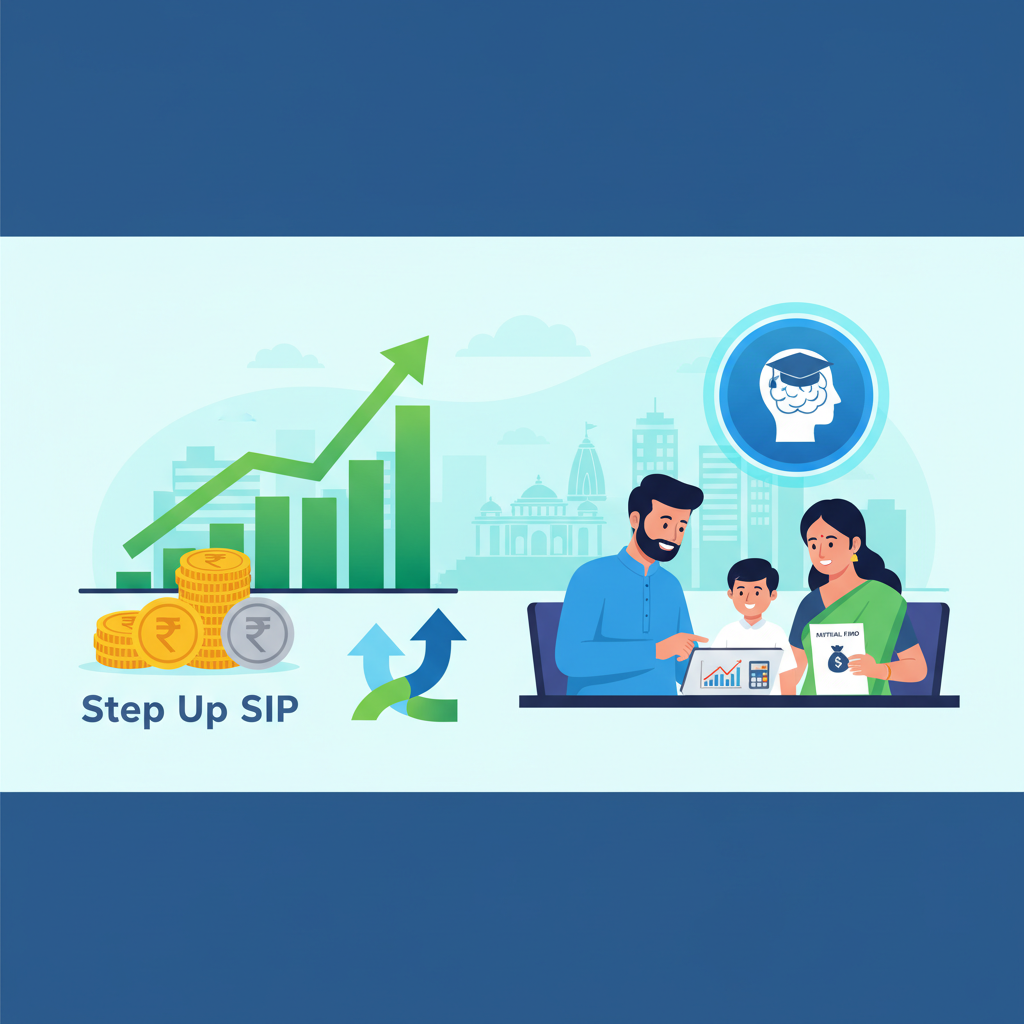
This is where the magic of a Step Up SIP comes in. Imagine it as a regular SIP with an annual 'raise' built-in. Every year, you automatically increase your SIP contribution by a certain percentage (say, 5%, 10%, or 15%). It's a small tweak that has a massive impact over the long run because of the power of compounding. You're essentially investing more when you earn more, accelerating your wealth creation without feeling a pinch.
Let me give you an example. Meet Priya from Pune. She started an SIP of ₹7,000 for her daughter's education when her daughter was just two years old. Her friend, Anita from Hyderabad, also started with ₹7,000 but opted for a 10% annual Step Up SIP. After 15 years, assuming both got an estimated 12% annual return (past performance is not indicative of future results), Anita's corpus would be significantly larger simply because she kept increasing her contributions in line with her growing salary. It's truly a game-changer.
Beating the Education Inflation Monster: A Step Up SIP Strategy
We talked about inflation, didn't we? It's the silent killer of purchasing power. Education costs in India have historically risen at an alarming rate, often between 8-12% annually, sometimes even more for specialized courses or international degrees. If you're saving for a goal 15 years out, that ₹15 lakh degree today could easily be ₹45-60 lakh then!
A Step Up SIP is your best bet to fight this monster. By increasing your contributions each year, you're not just investing more; you're also ensuring that your investments keep pace with, or even outpace, the rising costs. It's like having your savings run a marathon, but getting faster each lap!
How do you plan this? First, estimate the future cost of education. A good rule of thumb is to take the current cost and project it forward at an average education inflation rate of 10% per year. Then, use a goal SIP calculator to determine your initial monthly SIP. Finally, factor in your annual income growth to decide on a realistic step-up percentage. Most salaried professionals can comfortably manage a 10% annual step-up without feeling a significant burden.
For instance, Vikram, a software engineer in Chennai earning ₹1.2 lakh a month, wants ₹50 lakh in 15 years for his son's medical education. A regular SIP might suggest ₹15,000 a month. But with a 10% Step Up SIP, he might only need to start with ₹8,000-₹9,000 and gradually increase it, making it much more manageable in the initial years while still reaching his goal.
Choosing the Right Arsenal: Fund Categories for Your Child's Education Fund
Now that you're convinced about Step Up SIPs, the next question is: where do you actually invest this money? For a long-term goal like your child's education (10+ years), equity mutual funds are generally the preferred route because of their potential to generate inflation-beating returns. However, it's crucial to diversify and understand your risk tolerance.
Here’s what I’ve seen work for busy professionals:
- Flexi-Cap Funds: These funds have the flexibility to invest across market caps (large, mid, and small-cap companies), giving the fund manager the freedom to pick the best opportunities. This adaptability can be great for long-term growth.
- Multi-Cap Funds: Similar to flexi-cap but with a mandate to maintain a minimum allocation to large-cap, mid-cap, and small-cap stocks. Good for diversified exposure.
- Balanced Advantage Funds (BAFs): These are a hybrid category that dynamically adjust their equity and debt allocation based on market conditions. They aim to provide equity-like returns with potentially lower volatility, making them a good option if you're a bit cautious but still want growth.
As you get closer to the goal (say, 2-3 years away), it’s wise to gradually shift your investments from higher-risk equity funds to lower-risk debt funds or liquid funds. This is called 'derisking' and it protects your accumulated corpus from market volatility just when you need it most. This strategy is also known as asset allocation and it’s something SEBI-registered advisors often preach.
Common Mistakes Parents Make with Education Planning & SIPs
Even with the best intentions, it's easy to stumble. Here are a few pitfalls I've observed:
- Starting Too Late: The biggest mistake! Compounding needs time to work its magic. Delaying by even a few years can drastically increase the monthly SIP amount you need.
- Underestimating Future Costs: Parents often think of today's education costs. Remember that 10% annual inflation we discussed? Don't skimp on your projections.
- Not Stepping Up: You know your salary will increase, but if your SIP doesn't, you're leaving money on the table and making your goal harder to achieve.
- Panic Selling During Market Corrections: Markets go up and down. It's normal. For long-term goals, dips are often opportunities to buy more units at a lower price. Don't pull out your money based on short-term news cycles. Stick to the plan.
- Mixing Goals: Your child's education fund should ideally be separate from your retirement fund or vacation fund. Mixing them can lead to compromising one goal for another.
Honestly, most advisors won’t tell you this bluntly: consistency and patience are your biggest assets. The technicalities are secondary. Keep investing, keep stepping up, and let time do its job.
It’s about being proactive and strategic, rather than reactive. If you're a salaried professional with a steady income, a Step Up SIP perfectly aligns with your financial growth trajectory. Don't let the fear of future costs paralyze you. Take that first step, and then another, and another, by increasing your SIP amount each year.
Ready to see how a Step Up SIP can specifically work for your child's future education goals? Hop over to this Step Up SIP Calculator. Play around with different initial SIP amounts, step-up percentages, and tenures. You'll be amazed at the potential corpus you can build!
Happy investing!
This blog post is for educational and informational purposes only. This is not financial advice or a recommendation to buy or sell any specific mutual fund scheme. Mutual Fund investments are subject to market risks, read all scheme related documents carefully.