SIP vs PPF: Which is Better for Your Child's Future? | SIP Calculator

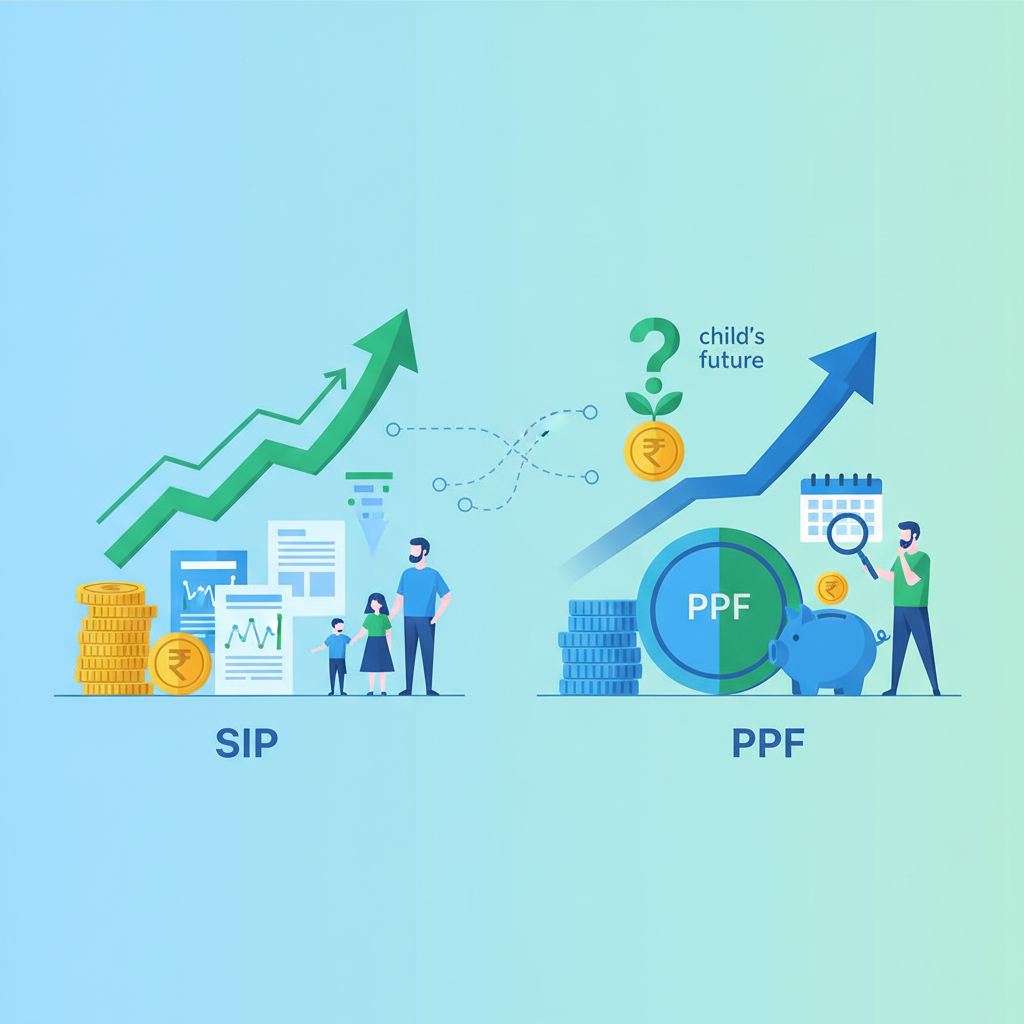
Siddharth sat at his dining table in his quiet Bengaluru apartment, staring blankly at two open browser tabs on his laptop. In one tab, his bank’s Public Provident Fund (PPF) portal showed a reassuring, sovereign-backed interest rate of 7.1%. In the other, a mutual fund dashboard displayed a volatile but historically attractive equity graph. His daughter, Aaradhya, had just celebrated her third birthday, and Siddharth—earning a comfortable salary of ₹1.8 Lakhs per month—was suddenly hit by the realization that higher education costs would skyrocket by the time she turned 18. He wanted to secure a reliable ₹50 Lakh education fund, but he was paralyzed by a classic dilemma: should he opt for the guaranteed safety of debt, or embrace the market-linked growth of equities? He found himself trapped in the eternal debate of SIP vs PPF: Which is Better for Your Child's Future? | SIP Calculator, a choice that millions of Indian salaried parents grapple with every single year.
Why We Stumble on the SIP vs PPF: Which is Better for Your Child's Future? Debate
The primary reason most salaried professionals struggle with this decision is a deep-seated psychological bias: loss aversion. As humans, we feel the pain of losing money twice as intensely as the joy of making it. The PPF, backed by the Government of India, offers absolute peace of mind. It feels safe because your principal is secure and the returns are completely tax-free under Section 80C. However, this safety is often an illusion when pitted against the real enemy of long-term wealth: lifestyle and education inflation.
While the Reserve Bank of India (RBI) aims to keep retail CPI inflation around 4% to 6%, higher education inflation in India is currently compounding at an alarming rate of 10% to 12% annually. A professional degree that costs ₹10 Lakhs today will easily cost ₹40 Lakhs to ₹50 Lakhs in fifteen years. If you put all your savings into a PPF account earning 7.1%, your real rate of return—after accounting for 10% education inflation—is actually negative. Your money is safe, but its purchasing power is systematically destroyed.
On the other hand, a Systematic Investment Plan (SIP) in equity mutual funds channelizes your money into India's economic growth. According to data tracked by the Association of Mutual Funds in India (AMFI), monthly SIP inflows in the country crossed the historic ₹20,000 crore mark in early 2024. This massive shift shows that Indian retail investors are increasingly recognizing equities as the premier asset class for beating long-term inflation. Yet, the fear of short-term market crashes keeps many parents from committing fully. The key is not to view this as a binary choice, but to understand how each instrument behaves over a 15-year horizon.
The Mathematical Showdown: SIP vs PPF: Which is Better for Your Child's Future?
To make an informed decision, we must analyze the math. Let us compare two distinct approaches using a hypothetical monthly investment of ₹10,000 over a 15-year horizon, which is the standard maturity period for a PPF account.
In a standard Public Provident Fund, your investment is capped at ₹1.5 Lakhs per financial year. Assuming the interest rate remains constant at the current 7.1% per annum, a monthly contribution of ₹10,000 for 15 years will result in a total investment of ₹18,000,000. The accumulated interest will be approximately ₹14,55,000, bringing your final tax-free maturity corpus to roughly ₹32,55,000. It is a highly predictable, risk-free outcome, but it falls significantly short of Siddharth’s ₹50 Lakh target.
Now, let us model an equity SIP investment. Historically, the Indian equity market, represented by the benchmark Nifty 50 Index, has delivered a CAGR of 12% to 14% over rolling 15-year periods. If we assume a conservative estimated return of 12% CAGR for an equity-oriented monthly SIP of ₹10,000 over 15 years, the math changes dramatically. While your total investment remains ₹18,000,000, your estimated final corpus leaps to approximately ₹50,45,000. Past performance is not indicative of future results, but the power of compounding over long horizons clearly favors equities.
But what if you do not settle for a flat SIP? This is where the Step-Up SIP formula comes into play. As a salaried professional, your income is likely to rise every year with annual increments. A Step-Up SIP automatically increases your monthly investment by a fixed percentage annually. Here is how the math works concretely:
In a flat monthly SIP, the future value is calculated using the standard formula:
FV = P * [((1 + r)^n - 1) / r] * (1 + r)
Where P is the monthly installment, r is the monthly interest rate, and n is the total number of months. However, a Step-Up SIP uses a compounding geometric progression. If you start with ₹10,000 per month and step up your investment by just 10% every year, your monthly contribution in Year 2 becomes ₹11,000, in Year 3 it becomes ₹12,100, and so on. Over 15 years, your total invested capital increases to ₹38,12,000, but your final estimated corpus at a 12% CAGR swells to an astounding ₹85,40,000. By aligning your investment growth with your salary growth, you easily overshoot your original goal.
Crafting the Ultimate Child's Education Investment Strategy
In my experience with analyzing family portfolios, the most successful parents do not choose between SIP and PPF; they build a hybrid asset allocation model. This approach combines the aggressive inflation-beating power of equities with the rock-solid stability of debt. Here is a step-by-step plan to structure your child's future portfolio based on their current age.
- The Accumulation Phase (Age 1 to 10): When your child is very young, time is your greatest asset. You can afford to take higher risks because the market has ample time to recover from temporary downturns. Allocate 80% of your investible surplus into equity mutual fund SIPs and 20% into PPF. Within your equity basket, diversify across SEBI-defined categories: use a Flexi-Cap Fund (which allows the fund manager to dynamically shift between large, mid, and small-cap stocks), and a Large-Cap Index Fund for steady, low-cost market exposure.
- The Consolidation Phase (Age 11 to 15): As your child enters middle school, the horizon shrinks. It is time to reduce volatility. Gradually shift your ratio to 60% equity and 40% debt. You can achieve this by directing new incremental investments into Balanced Advantage Funds (BAFs). These dynamic asset allocation schemes automatically reduce equity exposure when markets are overvalued and increase it when markets are cheap, protecting your accumulated gains.
- The De-risking Phase (Age 16 to 18): This is the most crucial phase that most parents ignore. With college admissions just two to three years away, you cannot afford to have your entire corpus sitting in volatile equities. If a sudden market correction occurs now, you will be forced to sell your mutual funds at a loss. Stop all equity SIPs and systematically transfer (using a Systematic Transfer Plan or STP) your accumulated equity corpus into safe Liquid Funds or short-term debt instruments. This ensures that when the admission fee invoice arrives, your cash is highly liquid and safe from market swings.
The Invisible Silent Killers: Tax Drag and Sequence of Returns Risk
When comparing SIP vs PPF, we must look beyond the basic return figures. There are two major factors that can quietly decimate your final payout: taxation and the sequence of returns. Understanding these advanced concepts is what separates amateur savers from sophisticated wealth creators.
First, let us address the tax drag. The PPF enjoys the coveted EEE (Exempt-Exempt-Exempt) status. Your annual investments are tax-deductible under Section 80C, the interest accumulated is tax-free, and the final maturity amount is entirely tax-exempt. Equity mutual funds, however, are subject to Capital Gains Tax. Under the current tax regime, Long-Term Capital Gains (LTCG) on equity mutual funds (held for more than 12 months) are taxed at 12.5% on gains exceeding ₹1.25 Lakhs in a financial year. While this tax drag does reduce your net yield slightly, the gross compounding advantage of equities still significantly outperforms the tax-free but lower yield of PPF over a 15-year timeline.
Second, we must understand Sequence of Returns Risk (SRR). Imagine two investors, Meera and Arjun, both investing ₹10,000 monthly for 15 years in equity SIPs. Both experience an average annualized return of 12% over the 15-year period. However, Meera experiences great market returns in the first 10 years and a massive market crash in years 14 and 15. Arjun experiences a flat, stagnant market in the first 5 years, but a massive bull run in years 13, 14, and 15. Even though their average mathematical return is the exact same, Arjun will end up with a vastly larger final corpus because the market surged when his accumulated capital was at its peak. To protect your child's future from this risk, a pre-planned, systematic exit strategy into debt instruments during the final three years of your goal is absolutely mandatory.
Pitfalls to Avoid in Your Child’s Wealth Creation Journey
One common trap is relying heavily on traditional child insurance plans or Unit Linked Insurance Plans (ULIPs). These products are often aggressively marketed as comprehensive solutions for a child's future. In reality, they are opaque, high-cost instruments that rarely yield more than 5% to 6% annualized returns, while locking up your capital for years with heavy surrender penalties. It is far more efficient to keep your insurance and investments strictly separate by buying a high-cover term insurance policy for yourself and investing the rest via direct mutual fund SIPs.
Another major mistake is failing to account for the impact of expense ratios on your mutual fund investments. Over a 15-to-20-year period, a 1% difference in the expense ratio between a Regular plan (bought through an agent) and a Direct plan (bought directly from the fund house) can wipe out lakhs of rupees from your final corpus. Always opt for Direct plans of mutual funds to ensure that every rupee of your hard-earned money compounds for your child’s benefit, rather than paying for intermediary commissions.
Lastly, many parents make the mistake of investing directly in the name of a minor child without understanding the tax implications. Under Section 64(1A) of the Income Tax Act, any income earned by a minor child is clubbed with the income of the parent who earns more. If you invest in mutual funds in your child's name, any short-term gains or dividends distributed will be taxed at your slab rate. To avoid unnecessary tax complexity, it is often cleaner to run the SIPs in your own name, tag them specifically for your child's education goal, and make your child the nominee or transfer the assets when they turn 18.
Map Your Journey with an Interactive SIP Calculator
Deciding between equity SIPs and PPF requires personalized calculations tailored to your specific monthly budget, target corpus, and investment timeline. To visualize how your monthly savings can grow and to compare the compounding power of regular investments versus stepped-up contributions, you should experiment with an interactive tool. You can use this comprehensive SIP Calculator to model various scenarios, adjust estimated return rates, and instantly see the potential value of your child's future education fund.
Mutual Fund investments are subject to market risks. This article is for educational and informational purposes only and does not constitute financial advice. Please read all scheme-related documents carefully and consult a SEBI-registered investment advisor before investing.