Step-up SIP calculator: Reach ₹2 Crore for your child's education goal.

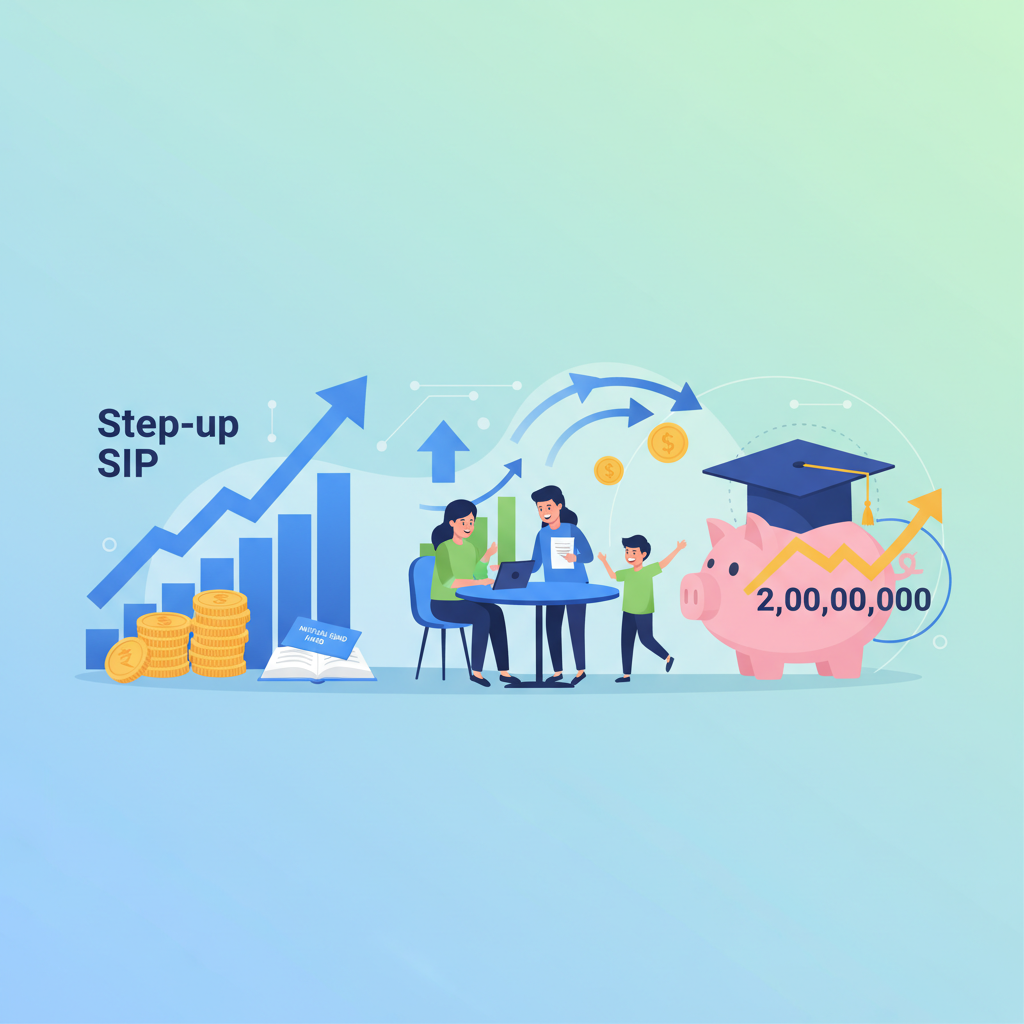
Remember that moment, staring at your little one, dreaming about their bright future? Maybe it's their infectious giggle as they chase a butterfly, or their determined frown as they try to stack blocks. And then, the thought creeps in: “What about their education?”
It’s a big one, isn’t it? Today, a decent B.Tech degree from a private university in Bengaluru can set you back upwards of ₹15-20 lakh. For an MBA from a top-tier institute? Easily ₹25-30 lakh. Now, fast forward 15-18 years. With education inflation often outpacing general inflation, that ₹20 lakh could easily become ₹80 lakh, or even a mind-boggling ₹1.5-2 crore! Pretty scary, right?
Most of us, the hardworking salaried professionals across India, instinctively turn to SIPs (Systematic Investment Plans). And yes, SIPs are fantastic. But here’s the thing: a fixed SIP, month after month, year after year, often isn’t enough to combat the beast that is education inflation. Your salary grows, your expenses grow, and so should your investments. That’s where the often-overlooked, yet incredibly powerful, tool called a Step-up SIP calculator comes into play. It's the secret sauce to actually reaching that ₹2 Crore education goal for your child.
Why Your Regular SIP Might Need a Booster Shot (and the Step-up SIP Calculator Comes In)
Let's talk about Rahul, a software engineer in Hyderabad earning ₹1.2 lakh a month. He's a diligent saver and started a ₹15,000 SIP when his daughter, Maya, was born. He hopes to build a corpus for her engineering studies in 18 years. Great start, right? But here’s the catch.
Rahul's salary isn’t stagnant. He gets a 7-10% raise most years. His expenses, like rent and daily groceries, also inch up. But his SIP? It stays at ₹15,000. While ₹15,000 might have felt like a significant chunk of his income initially, after a few years and a couple of raises, it becomes a smaller and smaller percentage of his increasing income. It loses its punch against inflation.
This is a common scenario I’ve seen repeatedly over my 8+ years advising salaried professionals. People start strong, but then life happens, and their investment amount doesn't keep pace with their earning potential or, more importantly, their goals' escalating costs. A fixed SIP is like driving a car at a constant speed, while your destination (your child's education goal) keeps moving further away. You need to accelerate!
A Step-up SIP simply means you increase your SIP contribution by a fixed percentage or amount every year. It’s dynamic, just like your life and your income. It allows you to leverage your increasing income to supercharge your investments. And trust me, the impact is phenomenal.
How a Step-up SIP Works its Magic: The ₹2 Crore Dream with the Step-up SIP Calculator
Let's make this tangible. Imagine Anita from Pune. She earns ₹65,000 a month and her son, Rohan, is 3 years old. She wants ₹2 Crore for his higher education in 15 years. This is a big goal, so she’s aiming for an estimated 12% annual return from her mutual funds, which is a reasonable expectation for long-term equity investments (Past performance is not indicative of future results).
Scenario 1: Fixed SIP
- If Anita starts a fixed SIP of ₹35,000 per month and maintains it for 15 years, she would accumulate approximately ₹1.77 Crore. Close, but not quite ₹2 Crore.
Scenario 2: Step-up SIP
- What if Anita starts with a more manageable ₹15,000 SIP and decides to step it up by 10% every year?
- Year 1: ₹15,000/month
- Year 2: ₹16,500/month (10% increase)
- Year 3: ₹18,150/month
- ...and so on.
Using a Step-up SIP calculator, you’d see that with this approach, Anita would likely reach *over* ₹2.2 Crore in 15 years! She starts with less initial outflow, but the power of compounding combined with incremental increases helps her surpass her goal. Isn't that incredible?
The beauty of the step-up is that the increases often align with your annual appraisals or increments, making them less of a pinch. It feels natural to funnel a portion of your raise directly into your child's future.
Picking the Right Horses: Fund Categories for Your Child's Future Goal
Now, when we’re talking about a long-term goal like your child’s education, which could be 10, 15, or even 18 years away, equity-oriented mutual funds are generally your best bet. They have the potential to deliver inflation-beating returns over the long haul. Here’s what I’ve seen work well for busy professionals:
- Flexi-cap Funds: These funds offer fund managers the flexibility to invest across market capitalizations (large, mid, and small-cap companies) based on their view of the market. This adaptability can lead to better returns over time.
- Large-cap Funds: For a slightly more stable, yet still growth-oriented approach, large-cap funds invest primarily in well-established companies. They tend to be less volatile than mid or small-cap funds.
- Balanced Advantage Funds (BAFs): If you’re a bit wary of pure equity's ups and downs, BAFs are a good option. They dynamically manage their allocation between equity and debt based on market conditions, aiming to provide a smoother ride while still participating in equity growth.
Honestly, most advisors won't tell you this, but consistency in stepping up your SIP is often more important than constantly chasing the highest-return fund. The Nifty 50 and SENSEX have historically delivered strong returns over multi-decade periods, demonstrating the potential of equity markets. Your job is to stay invested and keep adding more.
Before investing, always read the Scheme Information Document (SID) and Key Information Memorandum (KIM) carefully. For detailed information on different mutual fund categories and their risks, you can always refer to resources from AMFI (Association of Mutual Funds in India).
Don't Trip on These Common Mistakes When Aiming for ₹2 Crore!
Even with the best intentions and a fantastic tool like the step-up SIP, people often make a few common missteps that can derail their goals:
- Not Stepping Up (The Obvious One!): This is the biggest irony. You understand the concept, but then life gets busy, and you simply forget to increase your SIP amount each year. Set an annual reminder! Link it to your appraisal cycle.
- Stopping SIPs During Market Dips: The market will have its ups and downs. That's normal. When markets correct, it's actually an opportunity to buy more units at a lower price. Panicking and stopping your SIP means you miss out on this advantage. Stay calm and stay invested.
- Chasing Last Year’s Best Fund: Funds that performed exceptionally well last year might not do so this year. Focus on diversified, well-managed funds suitable for your long-term goal, rather than chasing fads or short-term returns.
- Not Reviewing Your Portfolio: While you shouldn’t constantly tinker, a quick annual review of your portfolio and your goal progress is crucial. Are you on track? Do your funds still align with your objectives? Remember, this is about making adjustments, not making emotional decisions.
- Underestimating Inflation: Many people base their goals on today's costs. Always factor in education inflation (often 8-10% annually) when setting your target corpus.
Remember, this is for educational and informational purposes only. This is not financial advice or a recommendation to buy or sell any specific mutual fund scheme.
FAQs on Step-up SIPs and Child Education Goals
1. What exactly is a Step-up SIP?
A Step-up SIP, also known as a Top-up SIP or an increasing SIP, is a feature that allows you to periodically increase your SIP investment amount by a fixed percentage or a fixed amount. For instance, you can choose to increase your SIP by 10% every year, or by a fixed amount like ₹1,000 every six months.
2. How much should I step up my SIP by?
This depends on your income growth and your comfort level. A common practice is to increase your SIP by 5-15% annually. A good thumb rule is to align your step-up percentage with your expected annual salary increment. If you anticipate a 10% raise, stepping up your SIP by 7-8% can feel very manageable.
3. Which mutual funds are best for a child's education goal?
For long-term goals like a child's education (10+ years), equity-oriented funds are generally recommended due to their potential for higher returns. Flexi-cap funds, Large-cap funds, and sometimes Balanced Advantage Funds can be suitable options. Always consider your risk tolerance and consult a financial advisor if needed.
4. Can I stop my Step-up SIP anytime?
Yes, you can generally stop or pause your SIPs at any time by instructing the AMC (Asset Management Company) or your distributor. However, for a long-term goal like your child's education, it's best to maintain consistency to leverage the power of compounding and achieve your target corpus.
5. What happens if I miss a step-up?
If you miss increasing your SIP for a particular year, it's not the end of the world. You can always catch up the following year or reset your step-up schedule. The important thing is to get back on track and continue to increase your contributions as your income grows. The step-up SIP calculator can help you adjust your plan accordingly.
Your Child's Future Deserves This Extra Push!
Building a ₹2 Crore corpus for your child’s education might seem like a daunting task, but with the right strategy and consistent effort, it's absolutely achievable. A Step-up SIP isn’t just an investment tool; it’s a commitment to your child’s dreams, a way to make your money work harder as you earn more.
Don't just dream about that ₹2 Crore; start planning for it. Take a few minutes right now to play around with a Step-up SIP calculator. See how a small annual increase can lead to a massive difference in your final corpus. You’ll be amazed at what you can achieve!
Mutual Fund investments are subject to market risks, read all scheme related documents carefully.