Step-up SIP for home down payment: How much to save for ₹20 Lakh?

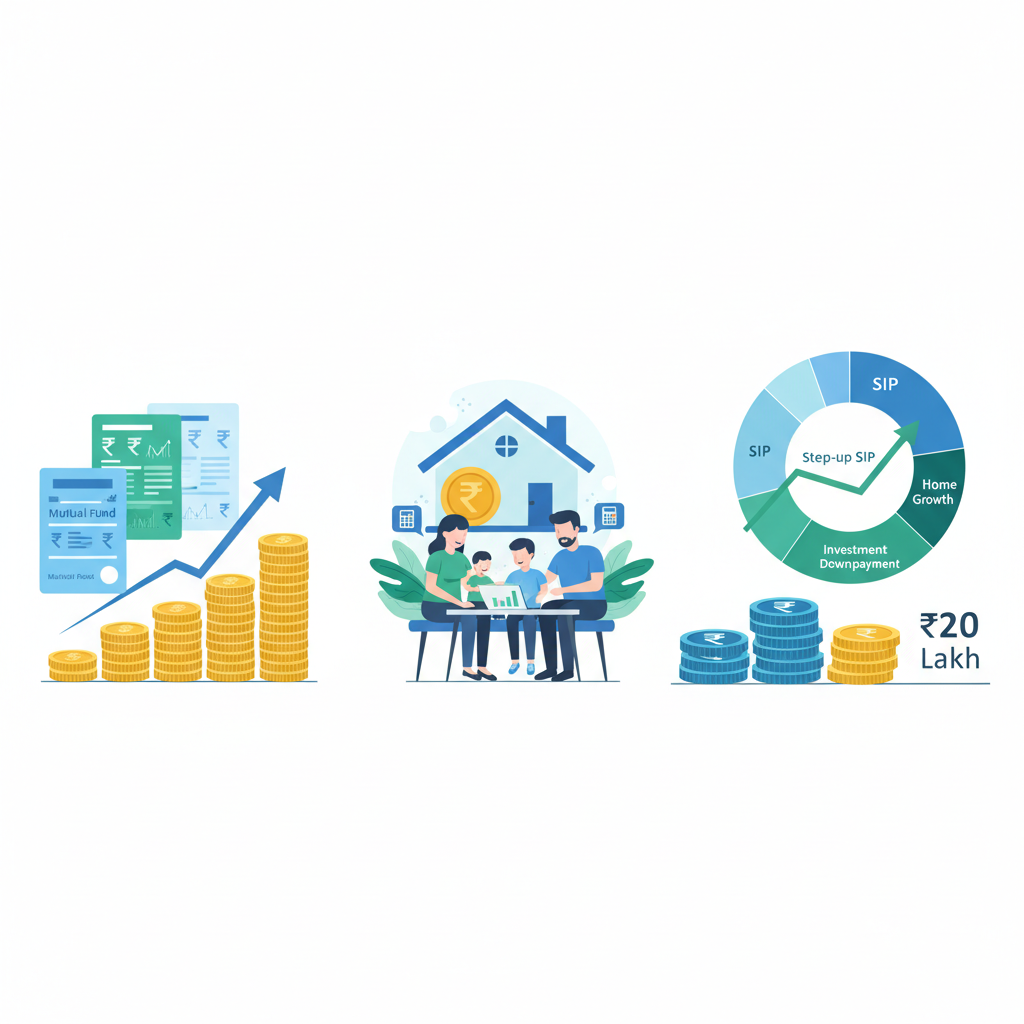
Alright, let's talk about that dream. The one where you're sipping chai on your own balcony, watching the world go by from your very own home in Pune, Bengaluru, or maybe even your hometown. Sounds amazing, right? But then reality hits: the down payment. It’s often the biggest hurdle, a formidable ₹20 Lakh (or even more!) staring you down, making you wonder if that dream is ever truly within reach.
Many of you, busy professionals juggling work, life, and maybe even a budding family, ask me: "Deepak, how do I even begin to save such a massive sum without feeling completely overwhelmed?" Sticking to a fixed SIP sometimes feels like trying to fill an Olympic swimming pool with a teacup, especially with property prices (and inflation!) refusing to sit still. That’s where a smart, dynamic strategy called a step-up SIP for home down payment isn't just a good idea; it's often your best bet.
Why a Fixed SIP Might Not Cut It for Your Dream Home Down Payment
Let's be real. Your salary isn't fixed, is it? Every year, with appraisals and promotions, you likely see a hike. But if your SIP amount stays the same, you're essentially letting your savings fall behind your earning potential. Think about Anita, a software engineer in Hyderabad. She started an SIP of ₹10,000 five years ago. Her salary has gone from ₹65,000 to ₹1.1 lakh/month, but her SIP? Still ₹10,000. She's leaving so much potential on the table!
Property values, on the other hand, march ever upward. A flat that cost ₹80 lakh today in Chennai might be ₹1 crore in five years. If you're saving for a ₹20 Lakh down payment, that ₹20 Lakh needs to keep pace, or you'll find yourself needing even more. A static SIP struggles to beat this twin challenge of rising property costs and inflation eating into your savings' value. It's like running on a treadmill – you're moving, but are you actually getting anywhere?
This is where your investment needs to work harder and smarter, just like you do. We need a strategy that grows with you, scaling up your savings power as your income increases. Enter the step-up SIP.
Understanding the Magic of Step-up SIPs: Priya's Story
So, what exactly is a step-up SIP? Simply put, it's a Systematic Investment Plan where you commit to increasing your investment amount by a certain percentage at regular intervals, usually annually. It’s like giving your SIP a raise every year, just as you get one!
Let me tell you about Priya, a marketing professional in Bengaluru. She earns ₹70,000 a month and dreams of a ₹90 lakh apartment, for which she needs a ₹18 lakh down payment in about 7 years. If she just started a fixed SIP of, say, ₹15,000/month, even at an estimated 13% annual return (and remember, past performance is not indicative of future results!), she'd end up with around ₹20 lakh. Great, right?
But here’s the kicker: with a step-up SIP. Priya decides she can comfortably increase her SIP by 10% every year, matching her expected salary hike. She starts with ₹15,000. In year 2, it's ₹16,500. Year 3, ₹18,150, and so on. Guess what? At the end of 7 years, with the same estimated return, she could potentially accumulate over ₹25 lakh! That's almost ₹5 lakh more, just by making small, incremental increases she barely feels. This isn't rocket science, my friend, it's just smart planning that leverages the incredible power of compounding over time.
Crunching the Numbers: How Much to Step-up for that ₹20 Lakh Down Payment
Okay, let's get down to the brass tacks. You have a target: ₹20 Lakh. You have a timeline: let's say 5-7 years, which is typical for a home down payment goal. And you have an estimated return: for this medium-term goal, aiming for a historical 12-14% from equity-oriented mutual funds is reasonable, but always remember, this is an estimate and not a guarantee. Equity markets are volatile.
Let’s take Vikram, a product manager in Mumbai, earning ₹1.5 lakh/month. He wants his ₹20 Lakh down payment in 6 years. He's comfortable starting an SIP of ₹20,000/month. If he just does a fixed SIP, he'd likely fall short of his target, even with a decent return. But he plans to step up his SIP by 10% annually, aligning with his appraisals.
Head over to a tool like the one at sipplancalculator.in/sip-step-up-calculator/. Plug in his numbers:
- Target Amount: ₹20,00,000
- Investment Period: 6 years
- Expected Annual Return: 13%
- Annual Step-up Rate: 10%
The calculator will show him that to reach ₹20 Lakh, he'd need an initial monthly SIP of approximately ₹18,500! See? By leveraging the step-up, he needs to start with *less* than his initial thought of ₹20,000 and still hits the goal, or can hit it with a higher surplus if he sticks to his ₹20,000 initial plan. Without the step-up, a fixed SIP of ₹20,000 for 6 years at 13% would only get him around ₹19.5 lakh. The step-up makes all the difference.
Play around with the step-up percentage. Maybe you expect a 5% hike, or perhaps a solid 15%. The beauty is, you can tailor it to your anticipated income growth. This isn't about magical returns; it's about smart, disciplined saving that adapts to your life.
Picking the Right Funds for Your Home Down Payment Goal
When you're saving for a significant goal like a home down payment over a 5-7 year horizon, you need funds that offer growth potential but also manage risk. Pure equity can be volatile in the short to medium term, but for goals beyond 3-5 years, it's essential to beat inflation. Here’s what I’ve seen work for busy professionals:
-
Flexi-cap Funds: My go-to recommendation for many professionals with a medium-term horizon. These funds have the flexibility to invest across large, mid, and small-cap companies, giving fund managers the freedom to adapt to market conditions. When large caps are flying, they can focus there. If mid-caps are doing well, they can shift. This adaptability helps in potentially generating good returns while spreading risk. Look for funds with a consistent track record.
-
Balanced Advantage Funds (BAFs): For those a bit more cautious, BAFs are fantastic. These funds dynamically manage asset allocation between equity and debt based on market valuations. When markets are expensive, they reduce equity exposure; when markets are cheap, they increase it. This helps reduce volatility compared to pure equity funds and offers a smoother ride, which is often preferred when you have a specific goal like a down payment in mind. They aim to provide stability with growth.
What about ELSS? While excellent for tax saving, remember they come with a 3-year lock-in. If your primary goal is the down payment, and you're not specifically looking for Section 80C benefits, then flexi-cap or balanced advantage funds offer more liquidity and direct alignment with your goal's horizon.
Remember, always look at the fund's expense ratio, fund manager's experience, and the fund's historical performance (again, past performance is not indicative of future results) before investing. Diversify across 2-3 good funds from these categories, rather than putting all your eggs in one basket.
Common Mistakes People Make When Saving for a Down Payment
After advising salaried professionals for 8+ years, I’ve seen a pattern of missteps that can derail even the best intentions. Here’s what most people get wrong:
-
Procrastination: "I'll start next year when I get my bonus." The biggest enemy of compounding is time. The earlier you start, the less you have to save monthly. Seriously, it's brutal what even a year or two can cost you in lost compounding.
-
Ignoring the Step-up: They start a SIP, but forget to increase it. Your income grows, but your savings don't. This is a missed opportunity, plain and simple.
-
Chasing Hot Funds: Looking at last year's top performer and jumping in, only to find it's cooled off. Honestly, most advisors won't tell you this, but consistency and discipline in your chosen funds beat chasing volatile, short-term returns every single time. Focus on funds that align with your goal, not just the latest buzz.
-
Underestimating the Down Payment: They calculate for ₹20 Lakh but forget about stamp duty, registration charges, society formation fees, and the initial interior work. Factor in at least an additional 10-15% over the raw down payment figure.
-
Lack of Discipline: Dipping into savings for an unplanned vacation or a new gadget. Your home down payment fund should be treated as sacred. Set it up, automate it, and let it grow.
I've seen so many busy professionals, like Vikram, who nearly made these errors but managed to course-correct in time. Learn from these common pitfalls!
This is for EDUCATIONAL and INFORMATIONAL purposes only. This is not financial advice or a recommendation to buy or sell any specific mutual fund scheme.
FAQs: Your Top Questions Answered
You've got questions, I've got answers. Here are some of the common ones I get:
What is the benefit of a step-up SIP?
It allows your investments to grow proportionally with your income and helps you reach larger financial goals faster. It also helps combat inflation, ensuring your savings maintain their purchasing power for your down payment.
How often should I increase my SIP amount?
Most people find it convenient to do it annually, aligning with their salary appraisals. Some prefer semi-annually if their income stream allows for more frequent increases. The key is consistency and making it a habit.
What if I can't step up my SIP one year?
Life happens, I get it! The beauty of a step-up SIP is its flexibility. You can pause the step-up for a year, reduce the percentage, or even skip it if your financial situation doesn't allow. The important thing is to restart or resume when you can. Don't let one missed year derail your entire plan.
Are mutual funds safe for a down payment?
Mutual funds, especially equity-oriented ones, are subject to market risks. However, over a medium to long term (5+ years), they historically offer the potential for higher returns compared to traditional options like FDs, which might not beat inflation. SEBI (Securities and Exchange Board of India) regulates the mutual fund industry, bringing transparency and investor protection, but risks always remain. They are not 'guaranteed' but aim for wealth creation.
Should I invest in ELSS for a home down payment?
ELSS (Equity Linked Savings Schemes) funds offer tax benefits under Section 80C with a 3-year lock-in period. If your home down payment goal aligns with this 3-year lock-in and you also need to save tax, they can be a good option. However, if your primary focus is solely on building the down payment corpus without tax considerations, other flexi-cap or balanced advantage funds might offer more liquidity at the goal's end without the mandatory lock-in.
Your Home Dream is Closer Than You Think
That ₹20 Lakh down payment might feel like a mountain today, but with the right strategy, it's entirely scalable. A disciplined **step-up SIP for your home down payment** is about leveraging your growing income to supercharge your savings, turning that daunting number into a tangible goal.
It’s about making your money work as hard as you do, consistently, intelligently. Your dream home isn't just a dream, it's a financial goal. And with a disciplined approach, it’s a very achievable one. Don't wait. Don't procrastinate. Start today.
Want to see how your numbers stack up and truly map out your home down payment strategy? Play around with the Step-up SIP calculator and start planning today. Your future self, sitting on that balcony, will thank you.
Mutual Fund investments are subject to market risks, read all scheme related documents carefully.